


By the time I reach the hospital near Jamestown’s salt-air streets, the morning rush has given way to a tired hush. The smell of disinfectant and sea breeze mingle in the first corridor as I pass beneath a concrete shell rising out front. Inside, splintered joists, dust, and broken plaster mark where the old HIV unit once stood. The passage feels like Ghana’s HIV response in miniature—progress under perpetual reconstruction.
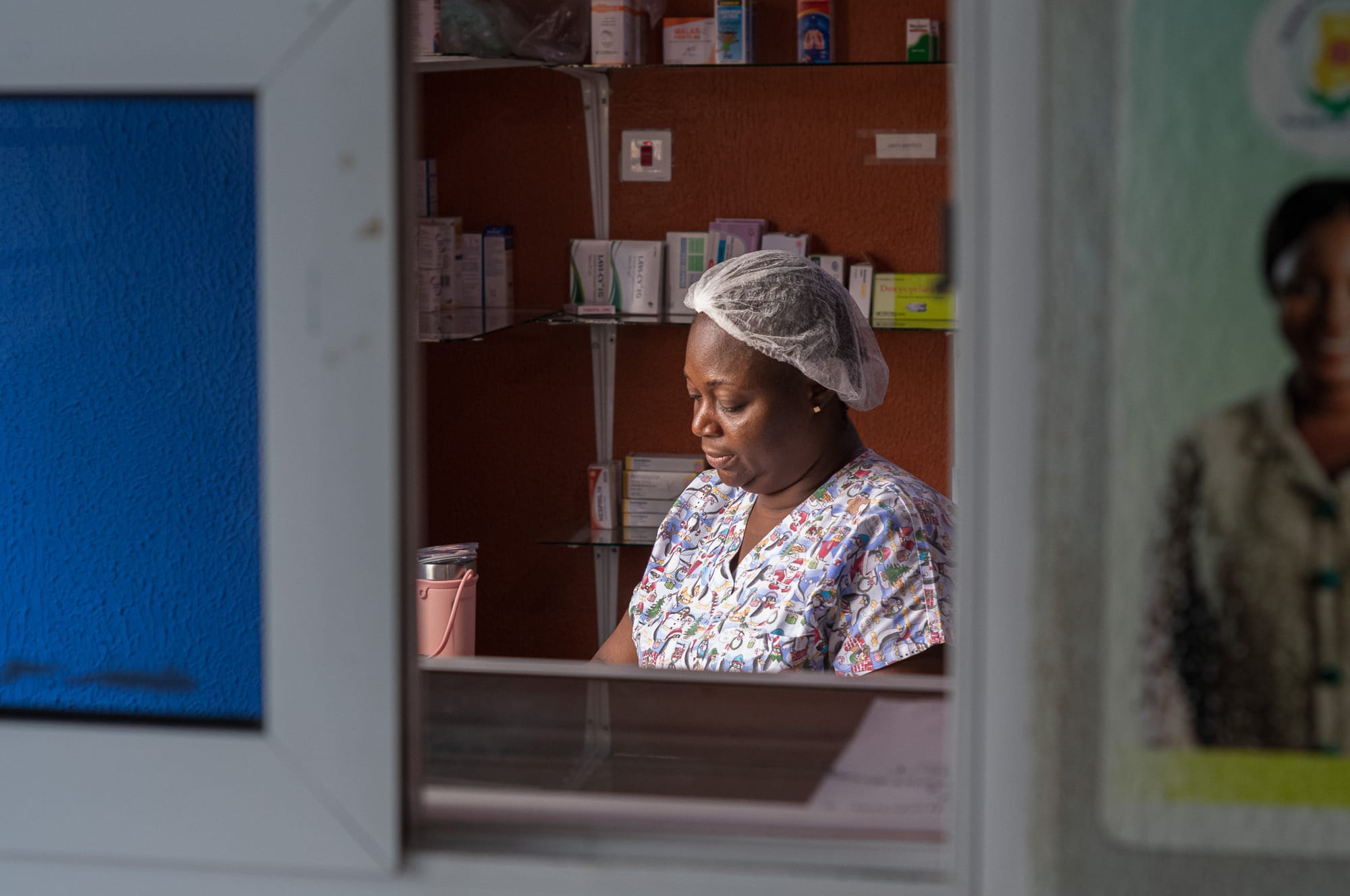
Through the debris, Ms. Juliet Enyonam Agbali, a public health nurse and HIV counsellor in Accra, appears in a purple campaign T-shirt. Her eyes are steady, offering the kind of composure that rewires the space around her.
As I gesture to the war zone I crossed to reach her, she says, “You need a calm room in your mind when the building around you is falling apart.” She guides me from the the adolescent unit where she now works to a gazebo behind the rubble. Sunlight drips through tiny holes in the roof. Everything feels precarious, yet Juliet’s voice steadies the space as she begins her story.
Becoming a nurse during the hardest years
Juliet’s journey into HIV care began almost by accident. Trained first as a community health nurse focused on child nutrition, she entered the profession in 2004. Meanwhile, Ghana’s HIV treatment programs were taking shape with major U.S. support through USAID and the newly launched PEPFAR initiative.
These worlds collided in 2008, when Juliet attended a single workshop on HIV care that would change her path, a time when working in HIV often meant standing beside families as they faced inevitable loss. In 2010 alone, Ghana reported nearly 20,000 AIDS-related deaths, of an estimated 310,000 people living with HIV.
“Back then, we prepared people to die. Now, we empower them to live,” Juliet says matter-of-factly.
After that workshop, she began HIV counseling, referring her clients to a handful of hospitals authorized to initiate treatment.
Decentralizing care
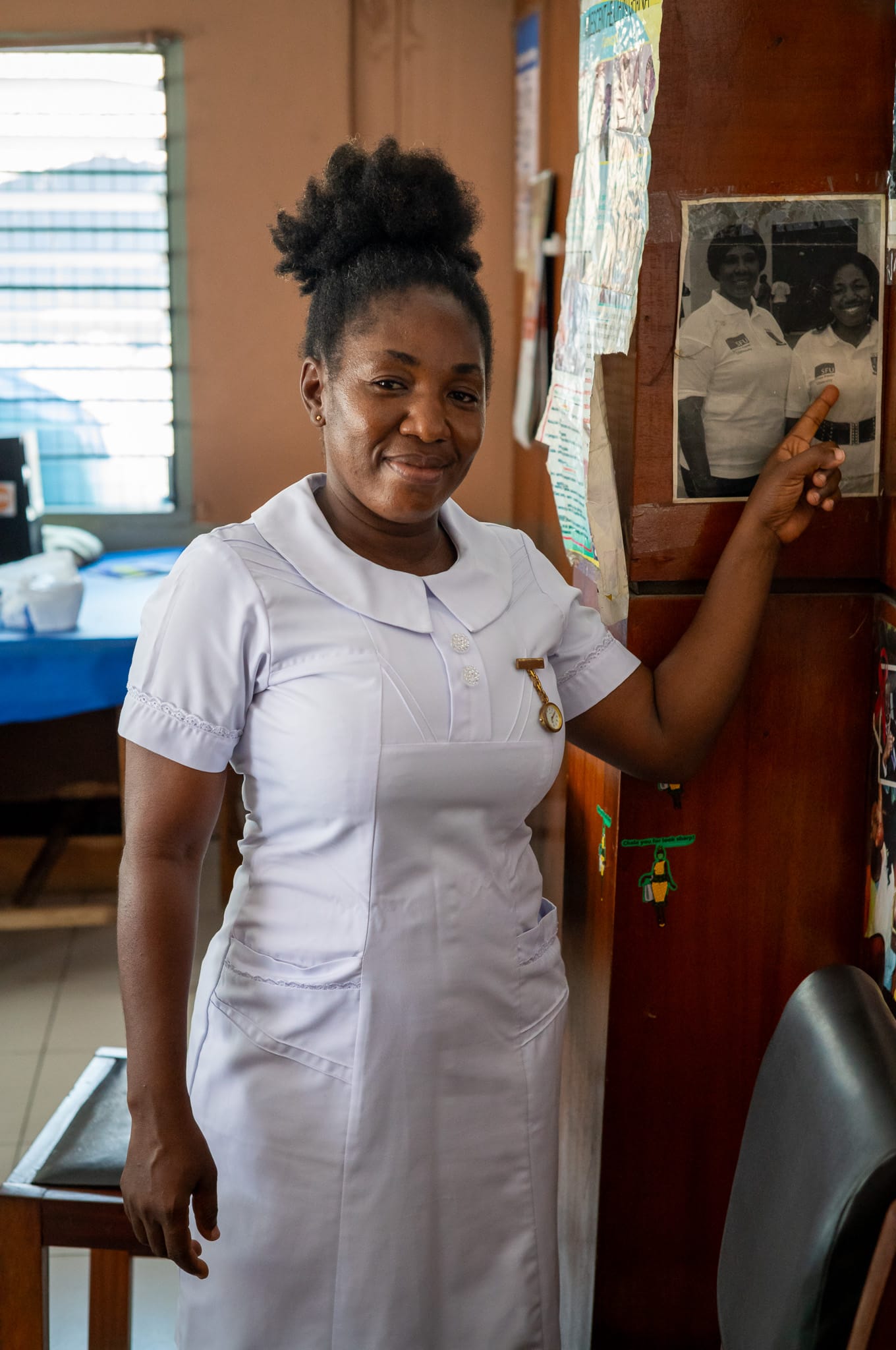
By 2012, Ghana’s HIV response was changing shape. Treatment had spread to roughly 160 facilities nationwide as care began to decentralize with steady U.S. backing. Juliet was part of that shift. Alongside a senior nurse and midwife (pictured below), she helped open her hospital’s first ART unit—a modest room, now being demolished, that symbolized something larger: the move from sending patients elsewhere to treating them herself.
It's a chapter she still carries with pride.
Yet something in those early experiences stayed with her. What started as curiosity became conviction. Over the years, she pursued additional degrees—including one in psychology—not for the promise of higher pay, but, as she explains, “so I could listen better.” She pauses before adding, “You learn to keep your own cup full.”
The weight of care
That cup must be deep. Across Ghana, burnout and stress have quietly taken root in the health workforce. A 2022 study of more than 1,200 health workers in Accra found that nearly one in five met the criteria for clinical burnout. Another, published the same year, showed that women and mid-career nurses were most affected.
Long hours, short staffing, and the emotional weight of care compound an unspoken expectation—to stay composed in the face of crisis. For counselors like Juliet, those crises arrive not as isolated emergencies but as a steady tide of worried faces, moments after clocking in.
Inside the clinic, every gesture seems small yet deliberate—rearranging test kits, aligning forms, a breath between patients. These are the micro-rituals that keep the day from spilling over. She has seen the emotional toll on her colleagues: sleeplessness, compassion fatigue, the quiet drift away from empathy that follows too much loss.
Her antidote? “Self-care isn’t indulgence,” she says, “it’s how I stay useful.”
Stigma's shadow
Stigma remains one of the heaviest weights in Ghana’s HIV response—a burden shared between patients and the people who care for them. Many of Juliet’s clients—men who have sex with men, transgender women, and sex workers—navigate lives shaped by overlapping forms of stigma and discrimination.
Without consistent training or supervision, these social attitudes easily spill into the health system. It only takes one person—a cleaner’s stare, a nurse’s moral warning, gossip between patients—for someone to feel unsafe in a clinic.
Adding to this pressure are legislative efforts to impose harsher penalties on LGBTQ+ people, pushing away the very communities Ghana needs to engage to end the epidemic. The result is predictable: many key populations avoid care altogether, even as their HIV prevalence remains far higher than the national average. And counselors like Juliet become both nurse and therapist, absorbing the community’s pain into their own nervous systems.
“The hardest part,” Juliet tells me, “is when someone stops coming. You think of them every day.”
The context is sobering, but perhaps it helps explain the country’s results—just 47% treatment coverage by 2024, far below neighboring countries and the epidemic-control targets set by UNAIDS. The numbers reveal a nation advancing, but too slowly: where access to treatment grows faster than the capacity to provide stigma-free, compassionate care. For Juliet’s patients, her reassurance remains a precious commodity.
The statistics tell the same story in numbers—steady progress shadowed by persistent inequity.
🔎 A closer look: Stigma, discrimination, and progress towards ending AIDS in Ghana
PLHIV and key populations
- In a 2023 study in Kumasi, over 90% of PLHIV reported experiencing stigma, and nearly as many said it affected their willingness to seek care.
- A 2024 survey across eight health facilities found that 57% of health workers reported observing discrimination toward PLHIV in the past six months.
- By comparison, the Ghana Stigma Index found only 4.3% of PLHIV reported discrimination in health facilities in 2020—down from 15% in 2014. Note: The data predate the renewed wave of stigma facing LGBTQ+ communities following the introduction of Ghana’s proposed anti-LGBTQ bill in 2024.
- A 2021 study across four cities found that nearly 50% of men who have sex with men had faced verbal abuse, 12% physical violence, and one in three sexual assault because of their sexuality.
- A 2022 study showed Ghanaian men who have sex with men are 11 times more likely to be living with HIV than the general population—an outcome of intersecting stigmas that erode trust in care.
Progress Toward Treatment Goals
- ART coverage in Ghana has risen from 35% (in 2008 for people with advanced HIV) to 47% (in 2024 for all PLHIV), contributing to a 36% decline in AIDS-related deaths since 2010.
- Ghana is still far from the 90–95% coverage needed for epidemic control and lagging behind neighbors:
- Côte d’Ivoire: 78% coverage, 75% fewer deaths.
- Burkina Faso: 82% coverage, 61% fewer deaths.
- Nigeria: 83% coverage, 58% fewer deaths.
Note: Ending the HIV epidemic requires more than expanding treatment coverage—it also depends on preventing new infections. Explore global prevention and treatment results in the UNAIDS AIDSinfo Databook.
Bridging the gap
For those who still hesitate to cross the threshold of a clinic, the bridge to care begins elsewhere. Juliet collaborates with partners like the Centre for Popular Education and Human Rights, Ghana (CEPEHRG), whose staff deliver PrEP refills and HIV self-test kits directly into communities.
Outside, a wiry case manager I call ‘Duah’ strides past the courtyard, four phones buzzing in his pockets. “One is for sports, one for clients, one for pageant work, and one backup,” he laughs, hoisting a backpack full of PrEP bottles before disappearing toward Jamestown’s alleys. His vanishing act feels emblematic of this work—bridging worlds, always in motion. Each phone holds a different version of his life: the peer counselor, the friend, the advocate, the performer. For a case manager serving MSM and transgender clients, those shifting identities are part of the job—balancing clinical worlds with the personal ones that make trust possible.
It’s Duah and others like him who extend Juliet’s calm beyond the clinic walls.
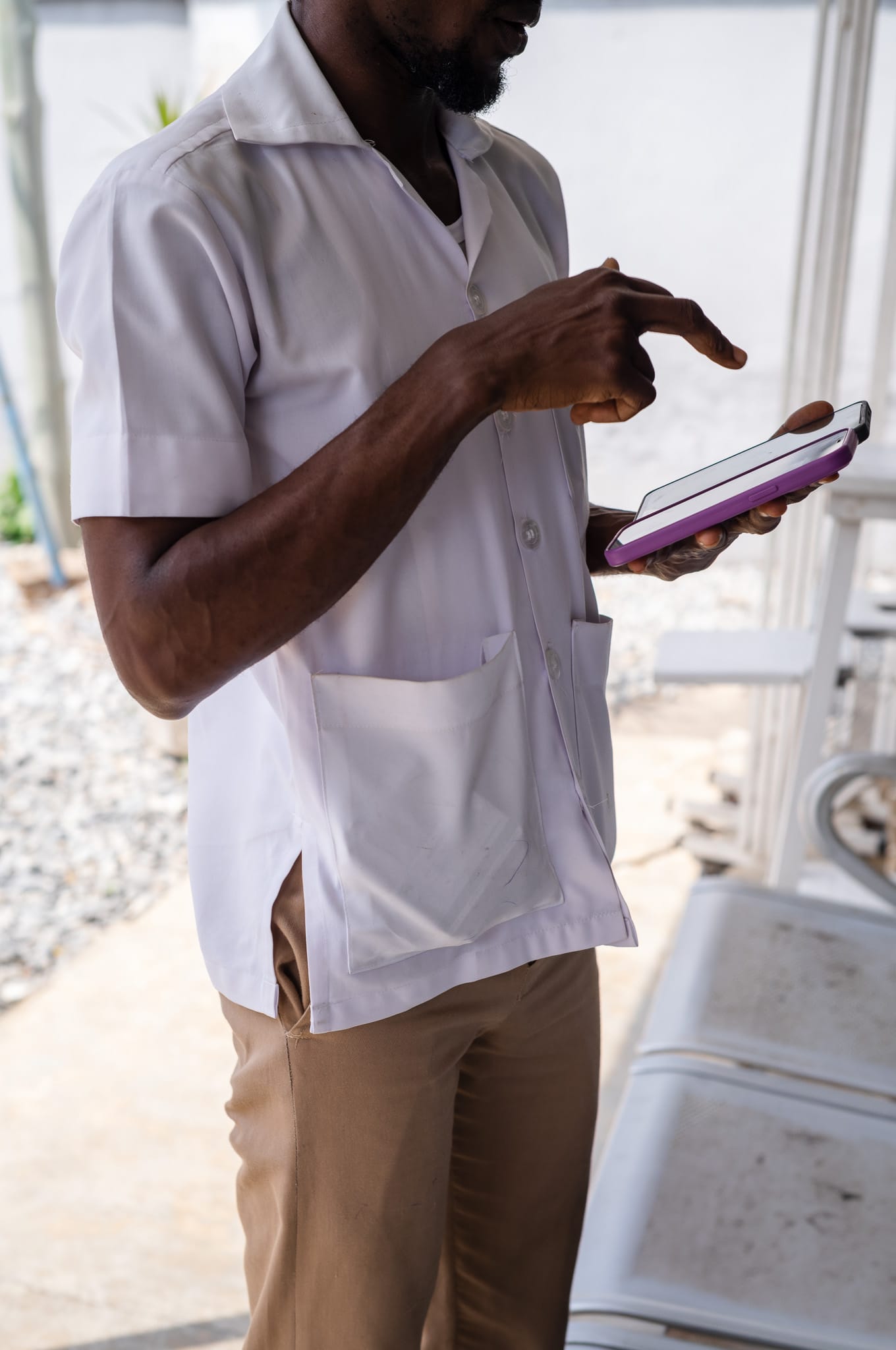
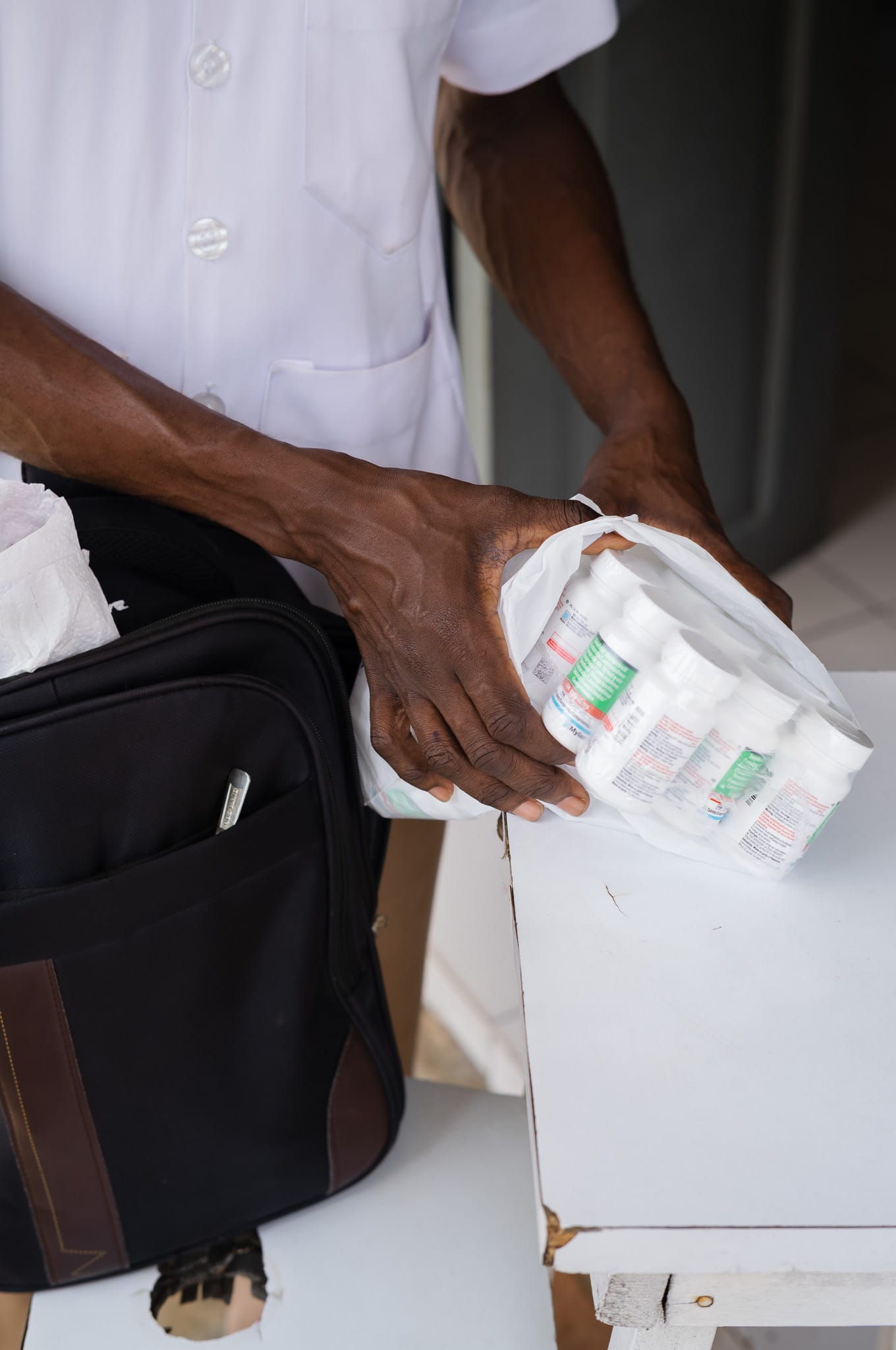
Juliet coordinates with 'Duah', case manager at CEPEHRG, to deliver PrEP refills to clients in Accra, Ghana. Photos by Ben Eveslage on 3 July 2025.
An outfit change and a snack break
When I ask for a portrait, Juliet smiles. “Should I change into my uniform?” Moments later, she re-emerges in pressed white—a symbol of both duty and distance. The uniform grants authority, but it can also build walls. She understands this instinctively, often choosing a simple campaign T-shirt instead, something that lets her meet patients on equal ground.
Near the end of her shift, Juliet and I cross the road for roasted plantain and peanuts. Between bites, she weighs the day’s contradictions: the joy of a client’s suppressed viral load against the ache of another lost to follow-up; the pride of an upcoming HIV-testing jamboree shadowed by pending legislation threatening those she serves.
I ask how she manages it all. “I don’t do much,” she admits. “Sometimes I wish I could take a holiday, but there are no funds. So I take advantage of small moments, like going to church with a friend. I’ve learned to keep an invisible box for work, so it doesn’t spill into my life.”
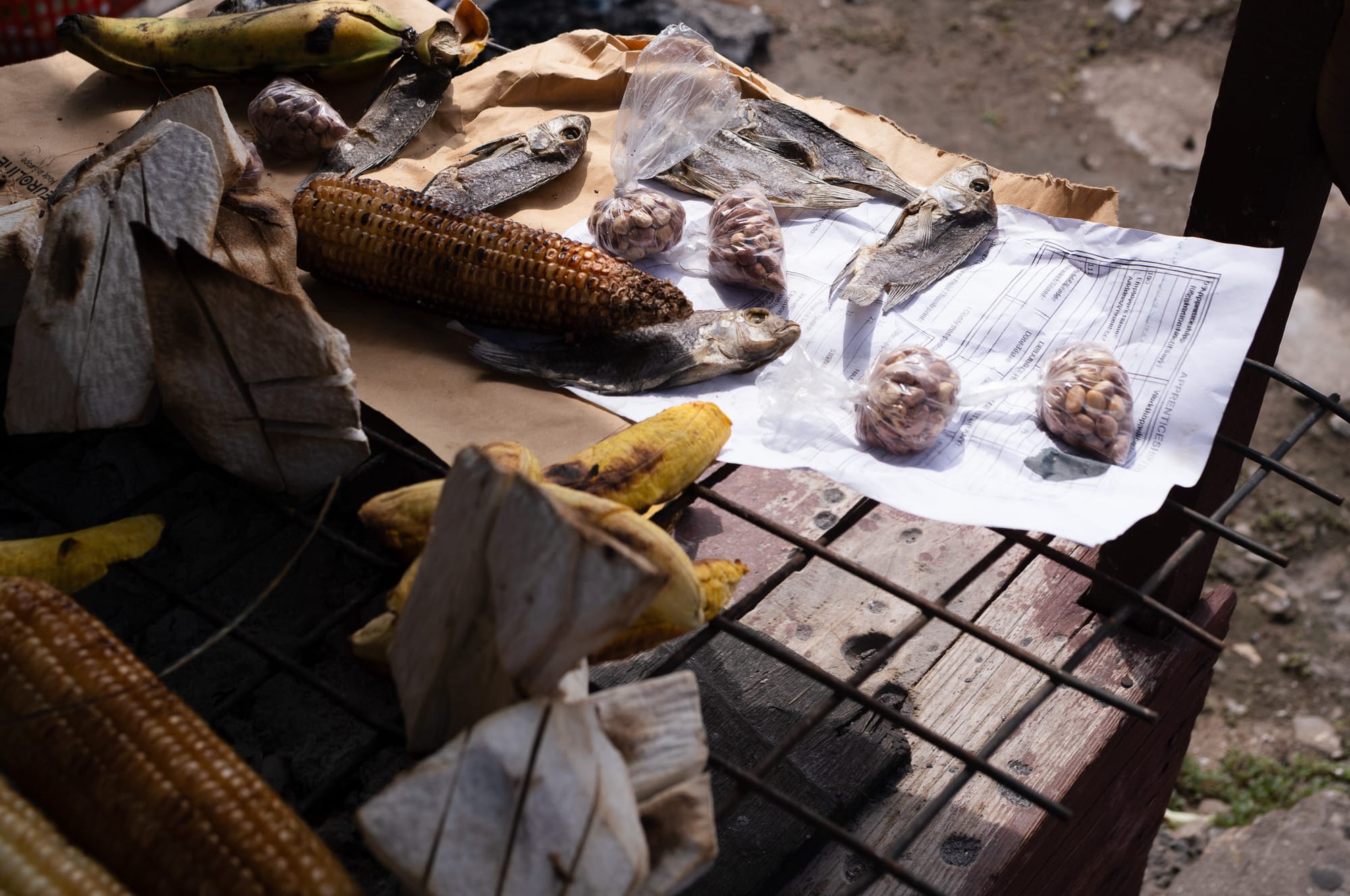
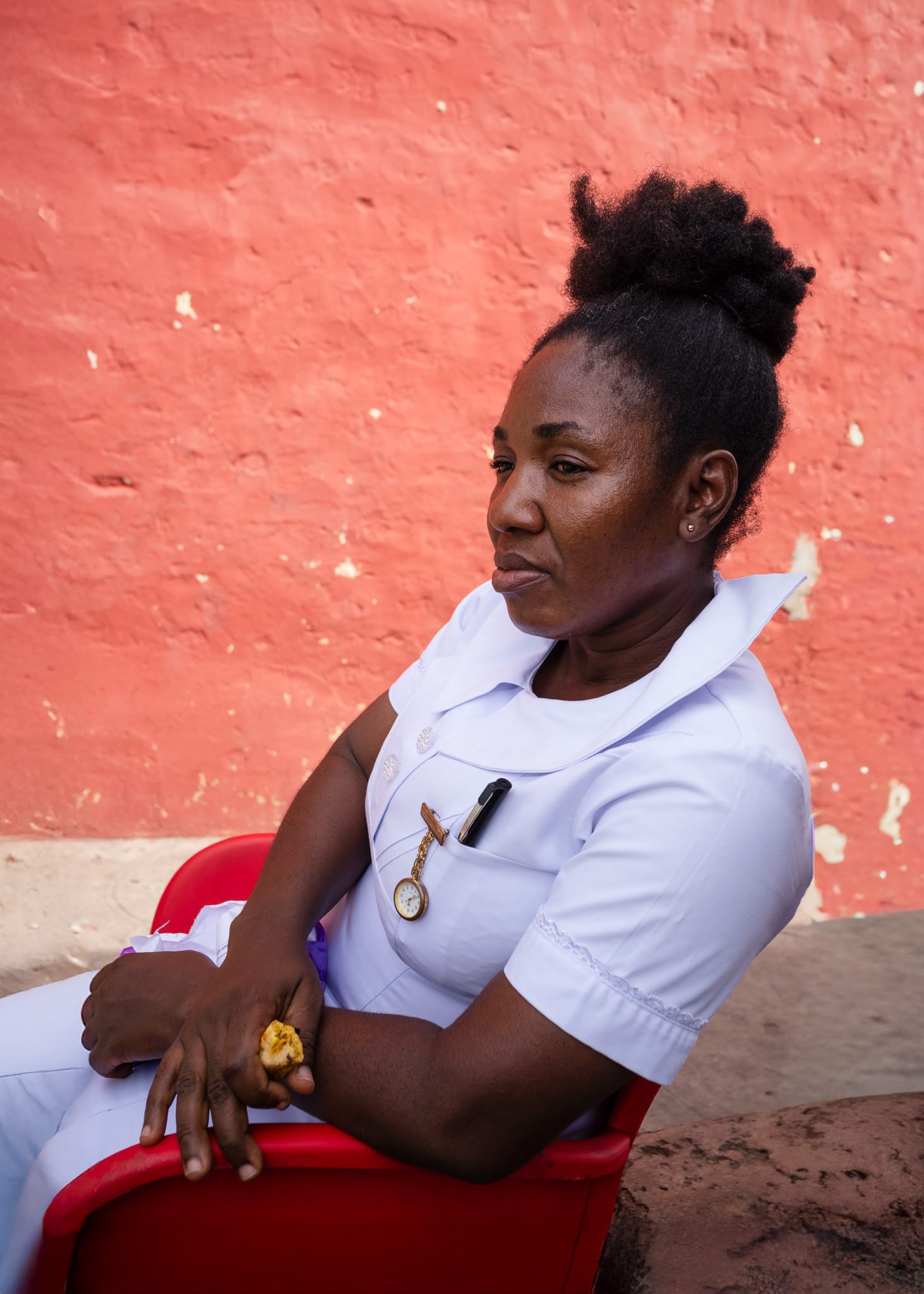
Juliet takes a snack break across the street from the hospital. Photos by Ben Eveslage 3 July 2025.
It isn’t meditation or therapy, nor any structured practice we might name, but something self-taught and effective. The psychology degree she earned years ago gave her language for emotion, yet what sustains her now is simpler—a habit of containment and the natural curiosity and compassion that have always drawn her to help others.
Calm within the chaos
The next morning I find her gloved and focused under a canvas awning at a public outreach event hosted by the Ghana AIDS Commission. The crowd surges. Dignitaries speak. Children weave between chairs. I arrived early to sit with Juliet—feeling the slight sting of the finger prick and the brief silence before results.
“What if my result is positive?” I ask, half-evaluating her counseling skills, half voicing my own insecurity.
She meets my eyes with a steady, sure smile. “Some things may be different,” she says softly, “but nothing you can’t manage.”
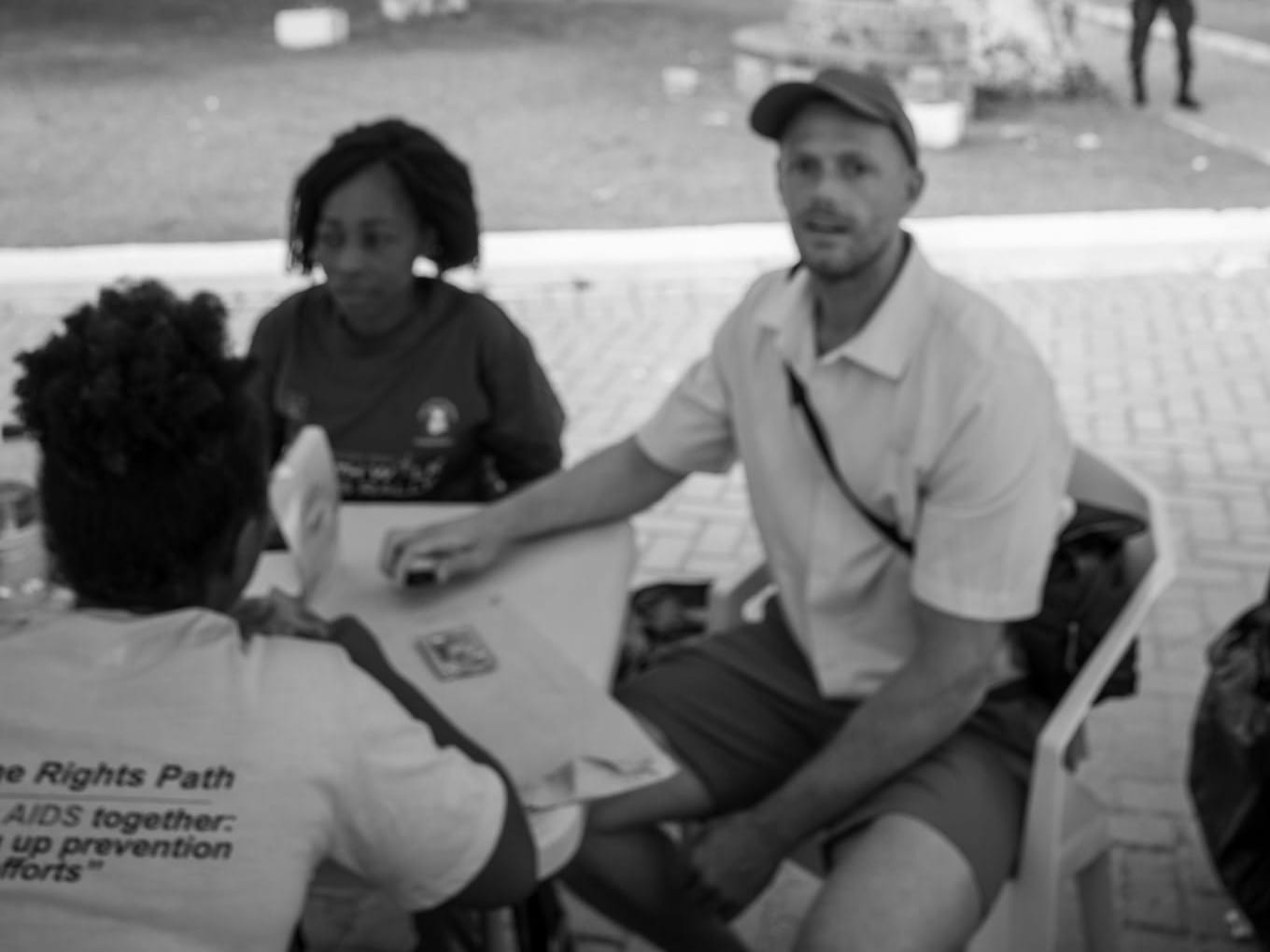
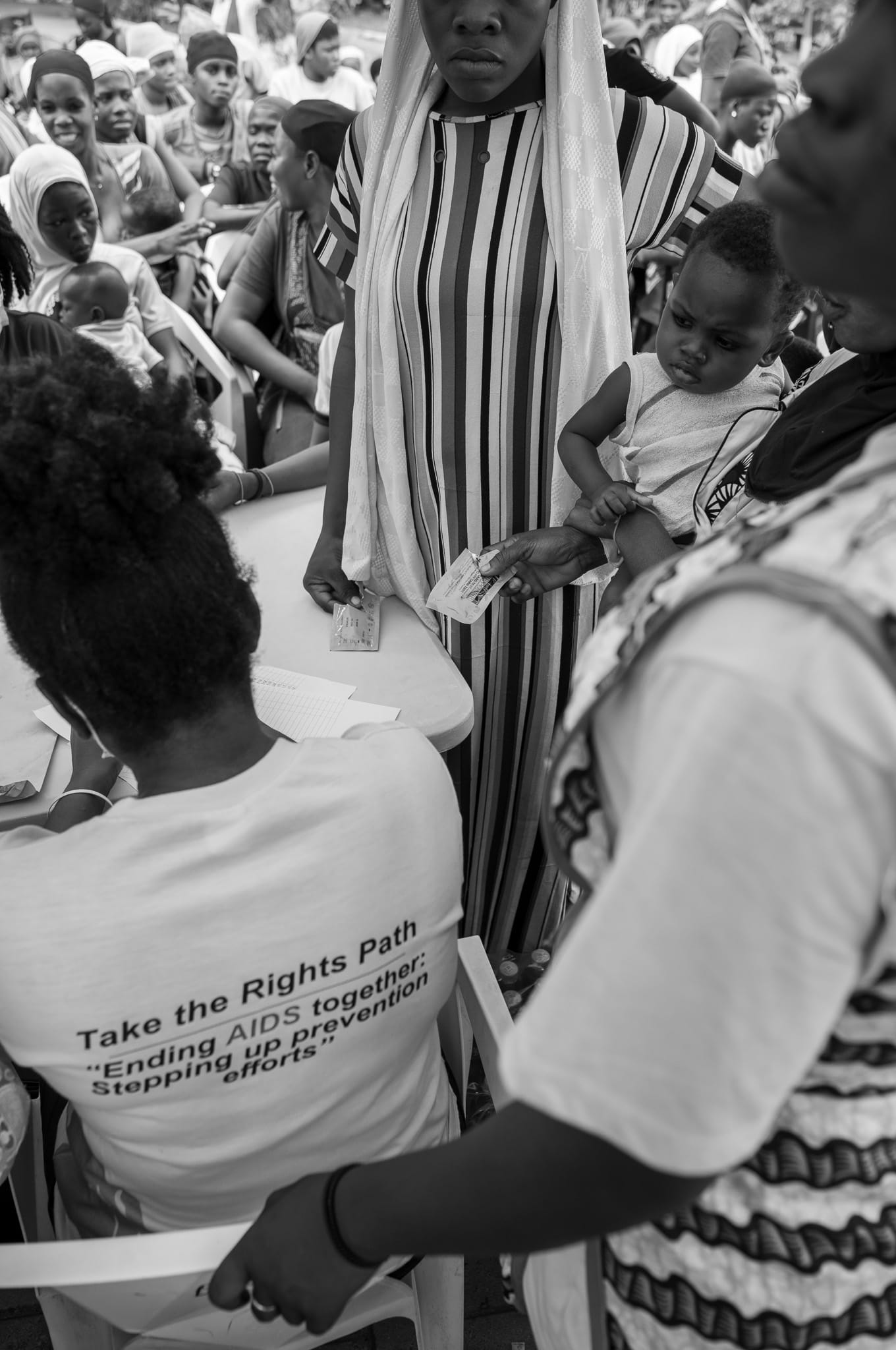
Juliet keeps working long after I leave, offering HIV testing and counseling to a swelling crowd of hundreds. Around her, the event hums with a kind of organized chaos—something only a hive mind could sustain. Patients coordinate informally, knowing who’s next in a queue that never quite forms a line. Nurses signal for refills of test kits and condoms. Volunteers shift plastic chairs and tables to match the shifting flow of people.
It becomes a frame of real-time triage—of both physical resources and emotional bandwidth.
Yet emotional bandwidth is a human commodity with limits. “Workload has increased,” she told me several months later, “because some organizations that were on USAID projects have stopped or reduced their activity.”
The stability of national funding keeps her salary paid and the hospital’s shelves stocked, but an open question remains: how far can that support go? Can it fill the gaps left by the decline of U.S. funding for community partners—those that extend the reach of clinics like Juliet’s—or train enough counselors in stigma-free care to share the growing weight of compassion?
In Ghana, as debates over harsher penalties for LGBTQ+ communities dominate headlines and donor funding wanes, the emotional burden on frontline workers grows heavier. Back at the hospital, the walls of Juliet’s former ward are stripped to rebar, yet her inner room stands whole. Around her, the scaffolding that once held Ghana’s HIV response—funding, partners, and people—is slowly being dismantled. Still, she keeps building calm from what remains.
It is here—between broken concrete and her steady gaze—that progress takes its most human form: fragile and unfinished, under perpetual reconstruction.
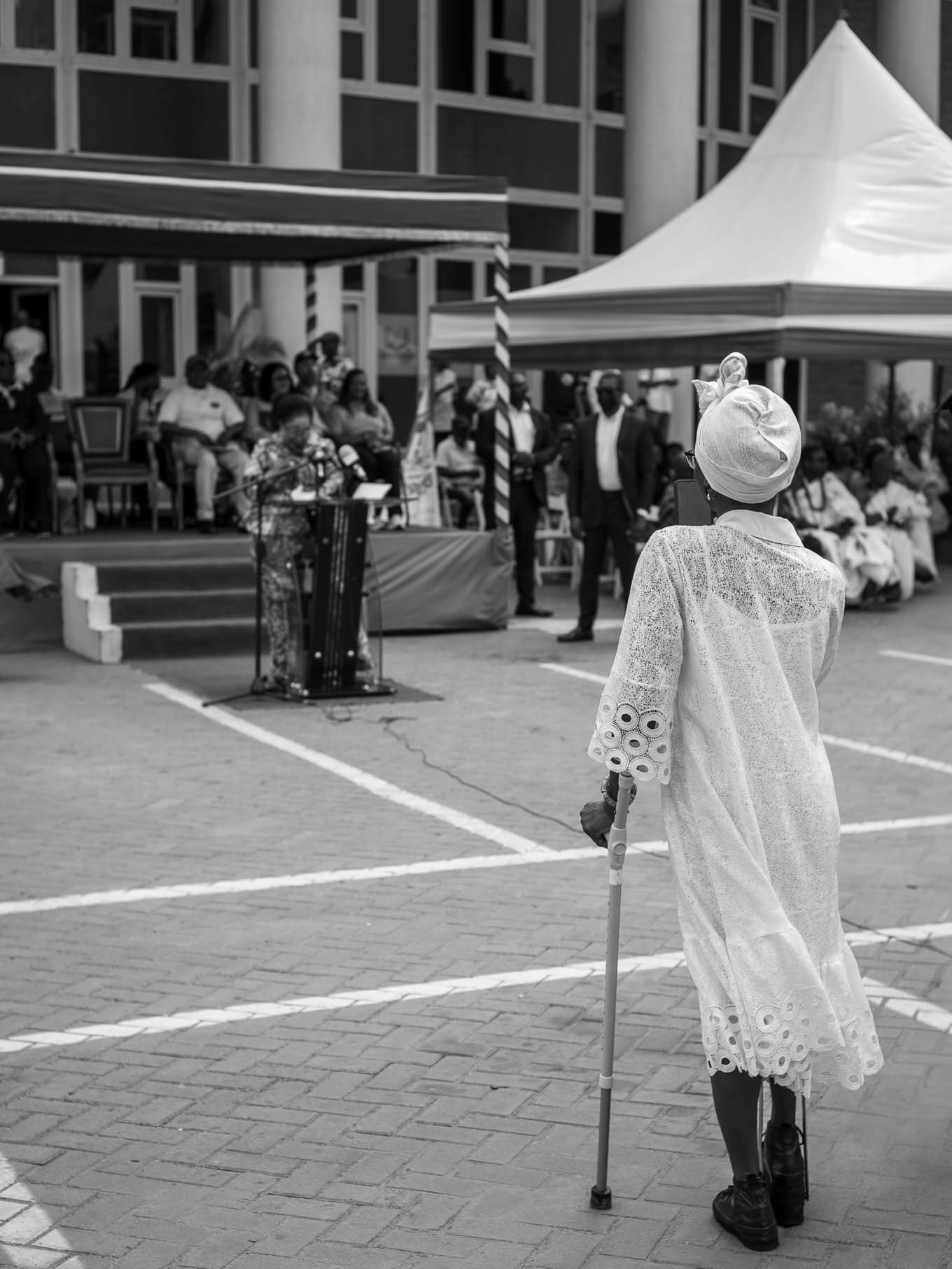
Featured local organizations
Ghana AIDS Commission (GAC)
Established by Act 938 in 2016, GAC coordinates Ghana’s HIV response across sectors, leading policy, planning, and monitoring. It sets national targets, supports prevention for key populations, and advances the 95-95-95 goals.
Center for Popular Education and Human Rights Ghana (CEPEHRG)
Founded in 1998, CEPEHRG advances HIV awareness and rights for youth and key populations in Ghana. Using education and community theatre, it delivers prevention, self-testing, and ART/PrEP services. Awarded UNDP Red Ribbon Award in 2008.
#close-up series
This series centers on individuals—the doctors, nurses, outreach workers, and advocates who share the human story of ending AIDS. Each piece captures one person’s story through portraiture, environment, and voice, pairing photographs with excerpts from intimate conversations. Explore the series →

Member discussion