


On a cool morning on the last day of July, I visited an HIV clinic just steps from the still waters of Lake Victoria in Entebbe, Uganda. There, I found Robert, or perhaps he found me, and in that conversation I began to understand how one person could embody so much of the global response to HIV, and what practiced resilience looks like.
On the road to Entebbe with Louis
The journey from Kampala felt like slowly waking from a stressful dream, the views outside the window gently overwriting the noise and urgency of the city.
Louis, a clinician and former colleague, picked me up after daybreak in his trusty Subaru. The oversized metal bumpers were a reminder of how precarious driving can be here, and how easily plans shift on the road.
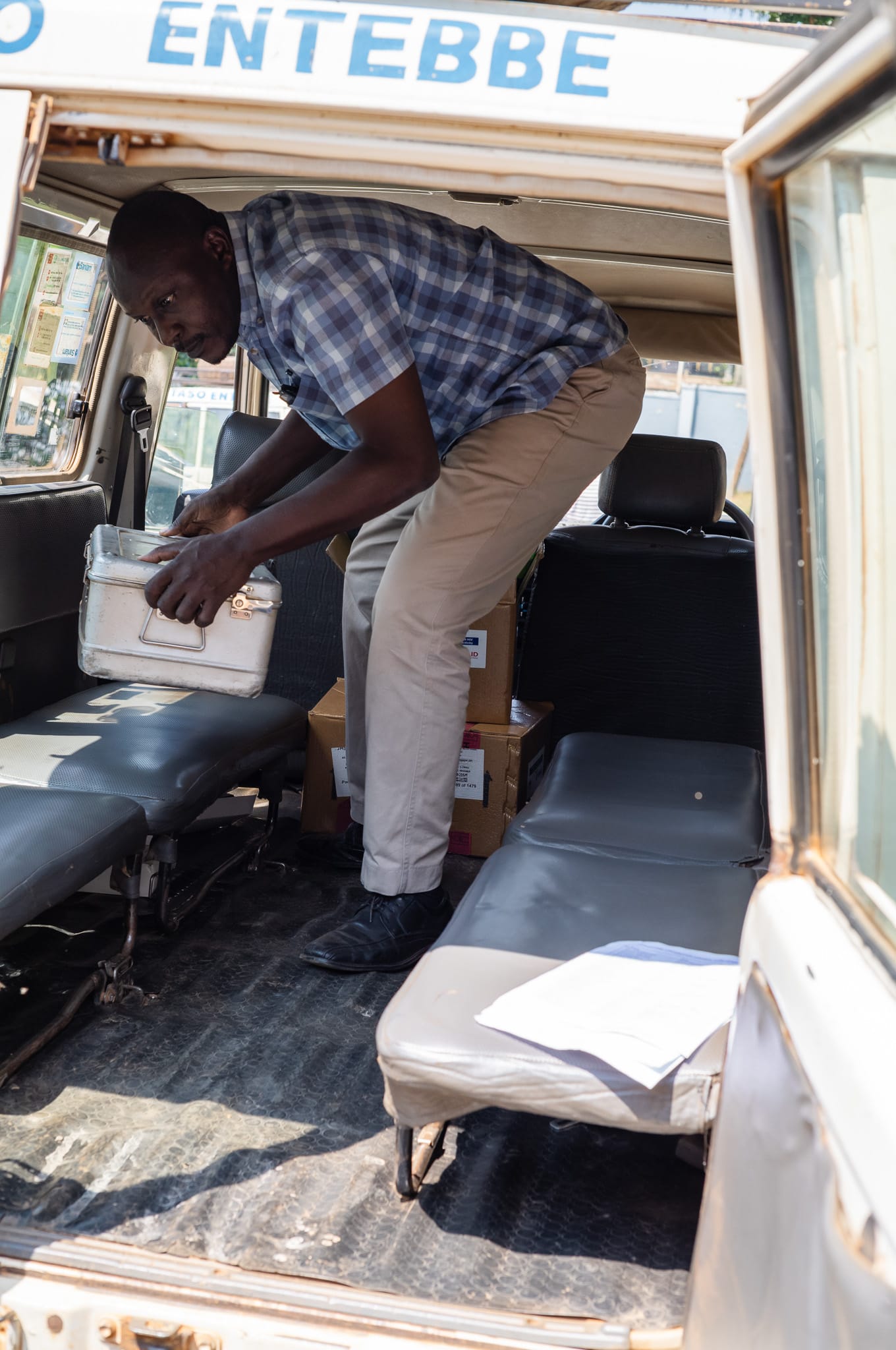
We moved through light traffic as the city woke, boda bodas flowing around us like water slipping past a rock in a river. Along the way, we recapped the previous days' meetings with organizations in Kampala, stories of confusion during the U.S. government stop-work orders, and the long tail of funding reductions still reshaping HIV programs months later.
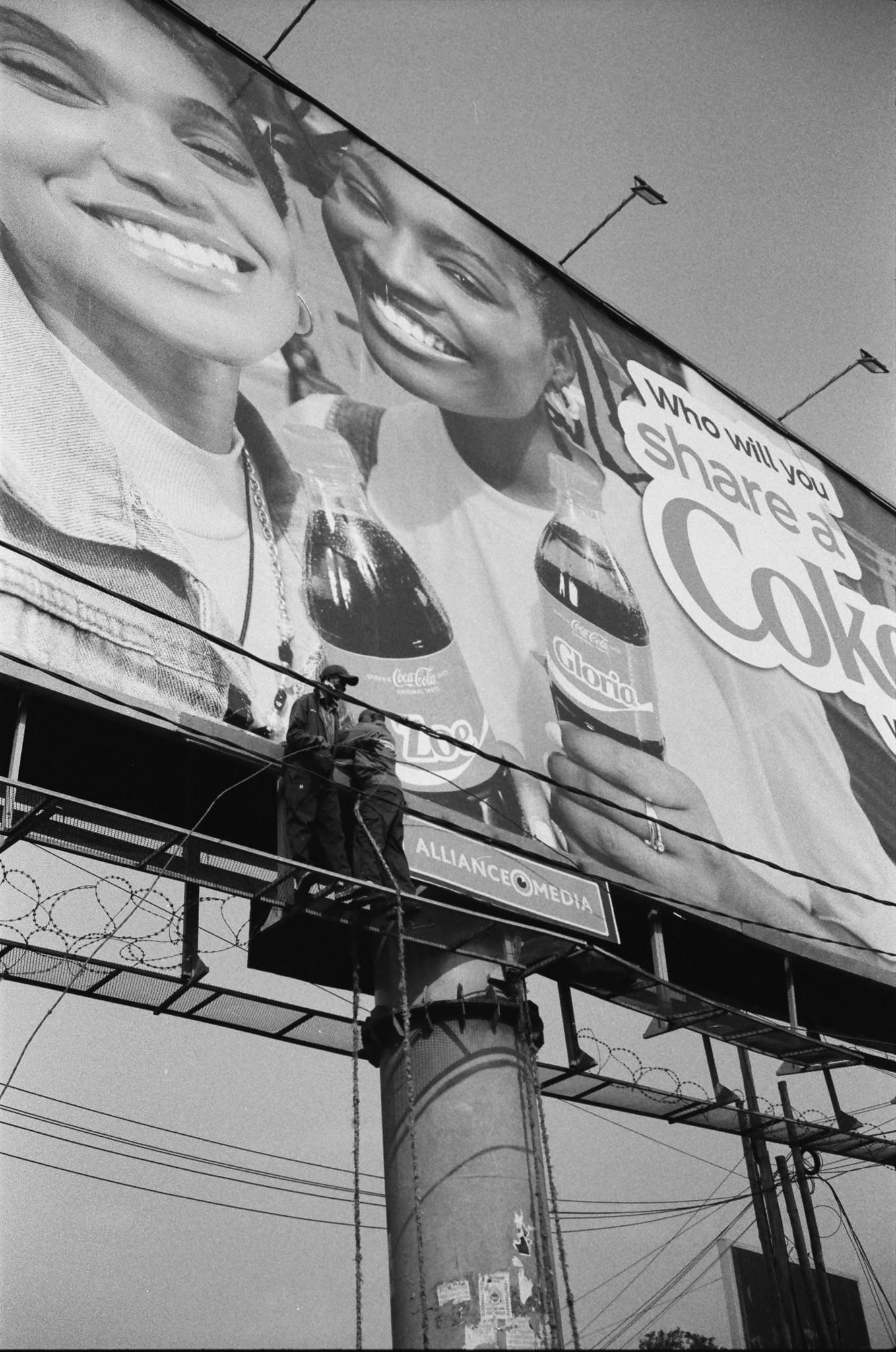
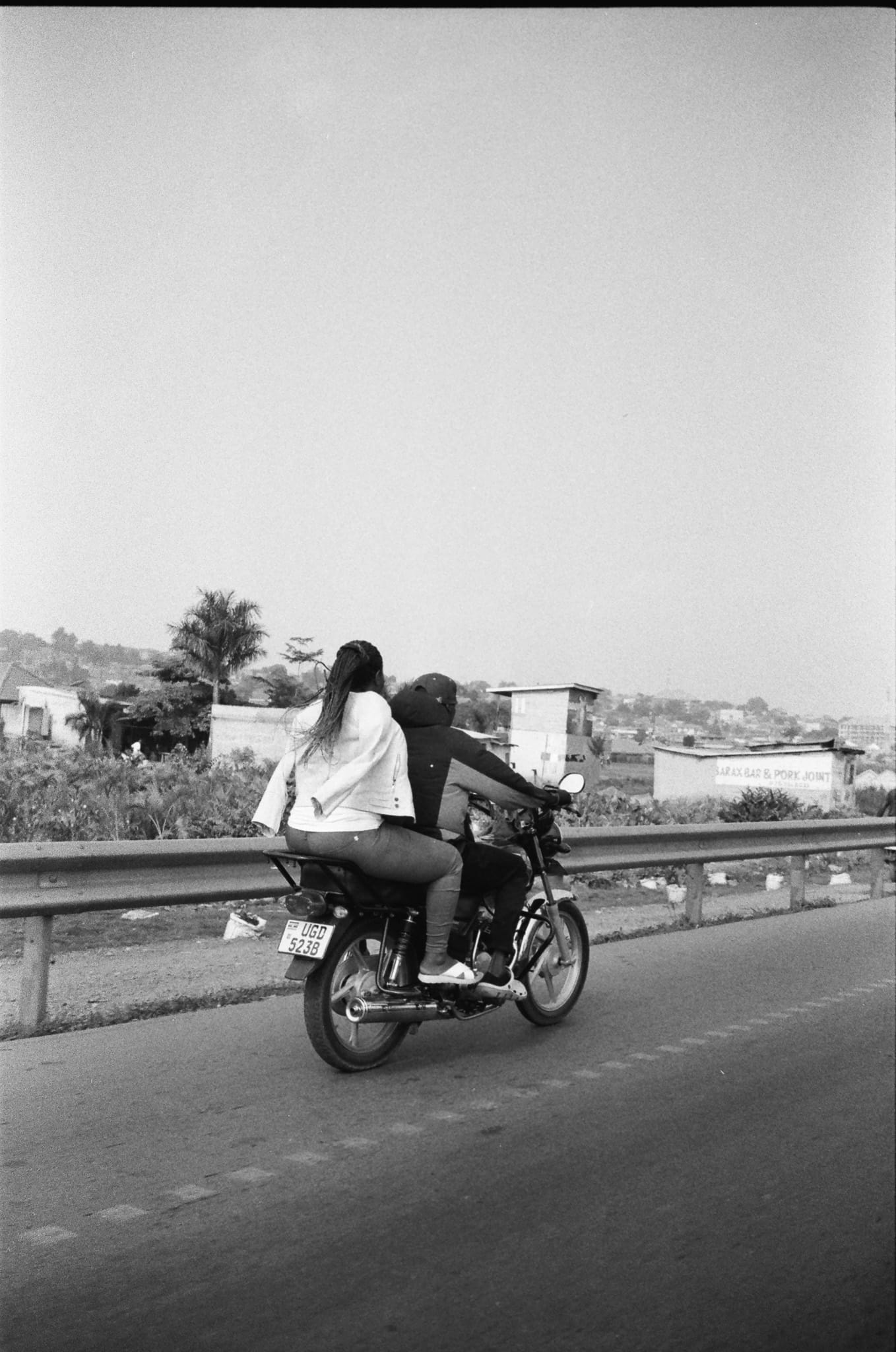
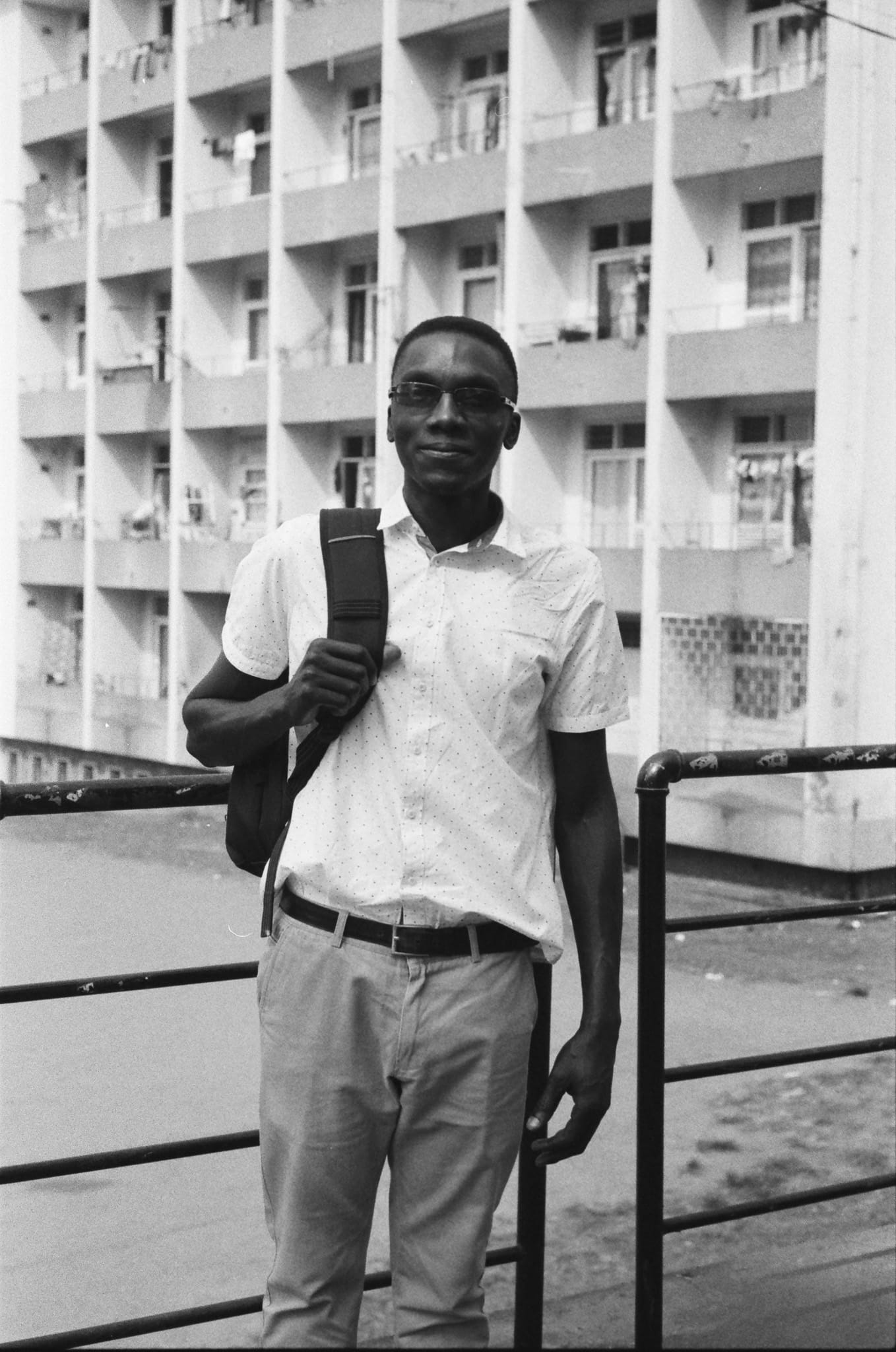
Street scenes in Kampala traffic including men working on a Coke-a-Cola billboard (left), a boda boda driver (center), and Louis at the Mulago Referral Hospital (right) on 30 July 2025. Analog 35mm photos by Ben Eveslage.
As we left the capital behind, the pace softened. The road opened into greener terrain, with flashes of Lake Victoria appearing beside us.
I knew this region carried deep history. Uganda’s first reported AIDS cases emerged not far from here in the early 1980s, and fishing communities along the lake have long borne a disproportionate HIV burden.
Away from the city’s urgency, I wondered how that history lived on now—how frontline staff carried it forward amid shrinking resources, and how they kept going, day after day, despite everything.
TASO: a "situationship" between community and state
We arrived at TASO Entebbe just after 9 a.m. and paused in the parking lot, unsure where to go. Though I’d been connected to the clinic manager by email and WhatsApp, the space itself felt unhurried. It gave me a moment to take it in: red-brick buildings, soft morning light, tidy gardens, pale yellow rooms visible through single-pane windows.
Louis seemed to understand my silence. He didn’t rush me or ask what I was looking for. I wasn’t searching for anything specific, just trying to absorb the light, the mood, the structure of the place before lifting the camera.
TASO Entebbe is a center of excellence within The AIDS Support Organisation (TASO), one of Uganda’s oldest and most influential HIV service organizations, founded in 1987 when HIV was still widely misunderstood and almost universally fatal. The Entebbe clinic opened in 1991 as part of TASO’s national expansion.
The complex felt deliberate. Unadorned. Built to last.
After visiting TASO headquarters in Kampala earlier that week, Louis clarify to me TASO’s distinctive role. Though independent, TASO has earned extraordinary trust over decades. Across Uganda, its clinics often operate alongside government hospitals, deeply integrated into the public health system.
Near the entrance, three brass plaques acknowledged donors and individuals who made the clinic possible.
Entebbe is different. It’s a standalone facility, yet it functions within the same collaborative model, drawing on national ART supply chains, public-sector partnerships, and donor funding to deliver clinical care, counseling, psychosocial support, and long-term follow-up under one roof.
In the lot, a motorbike stood with two small U.S. flags fixed to its handlebars.
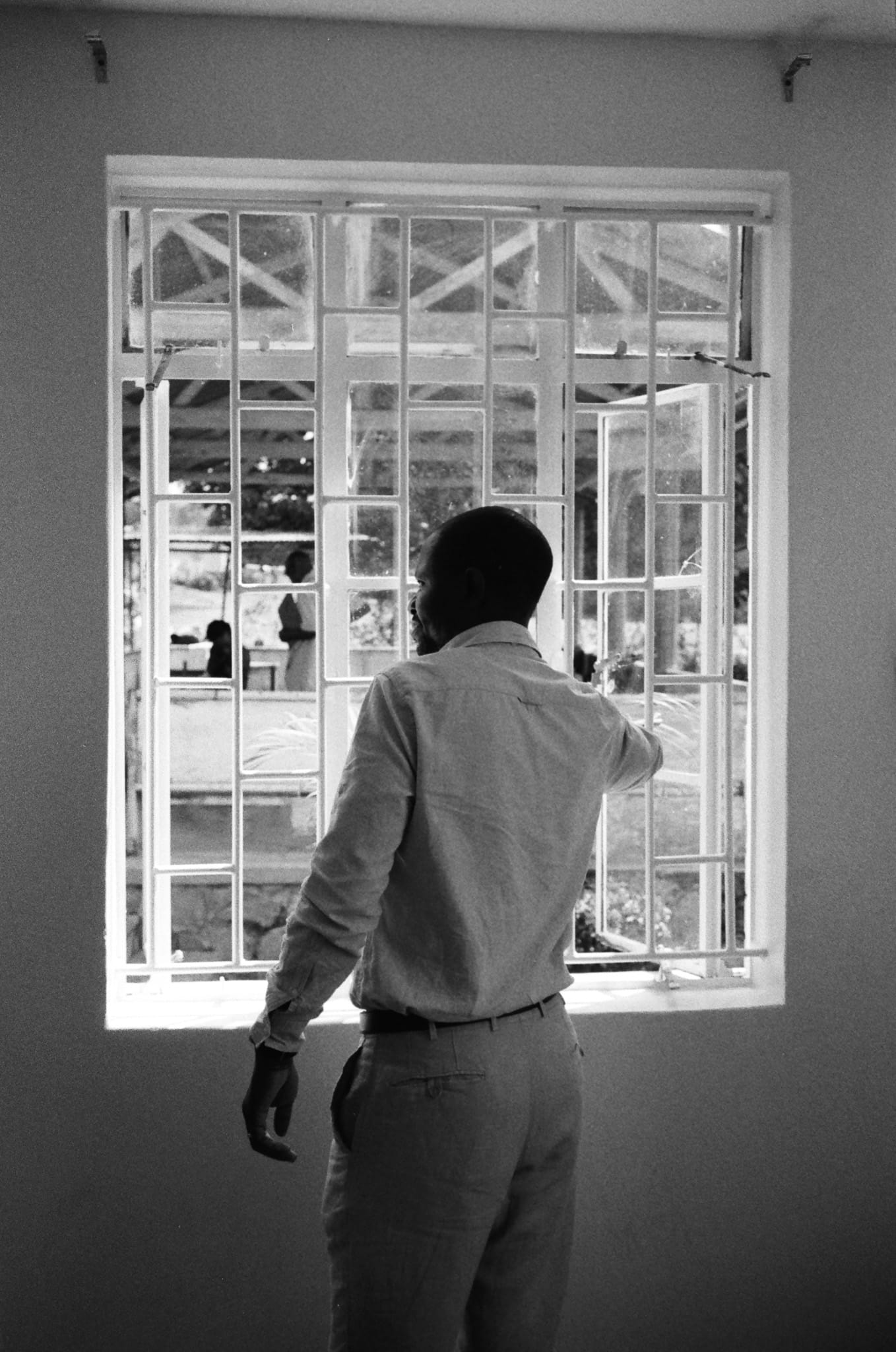
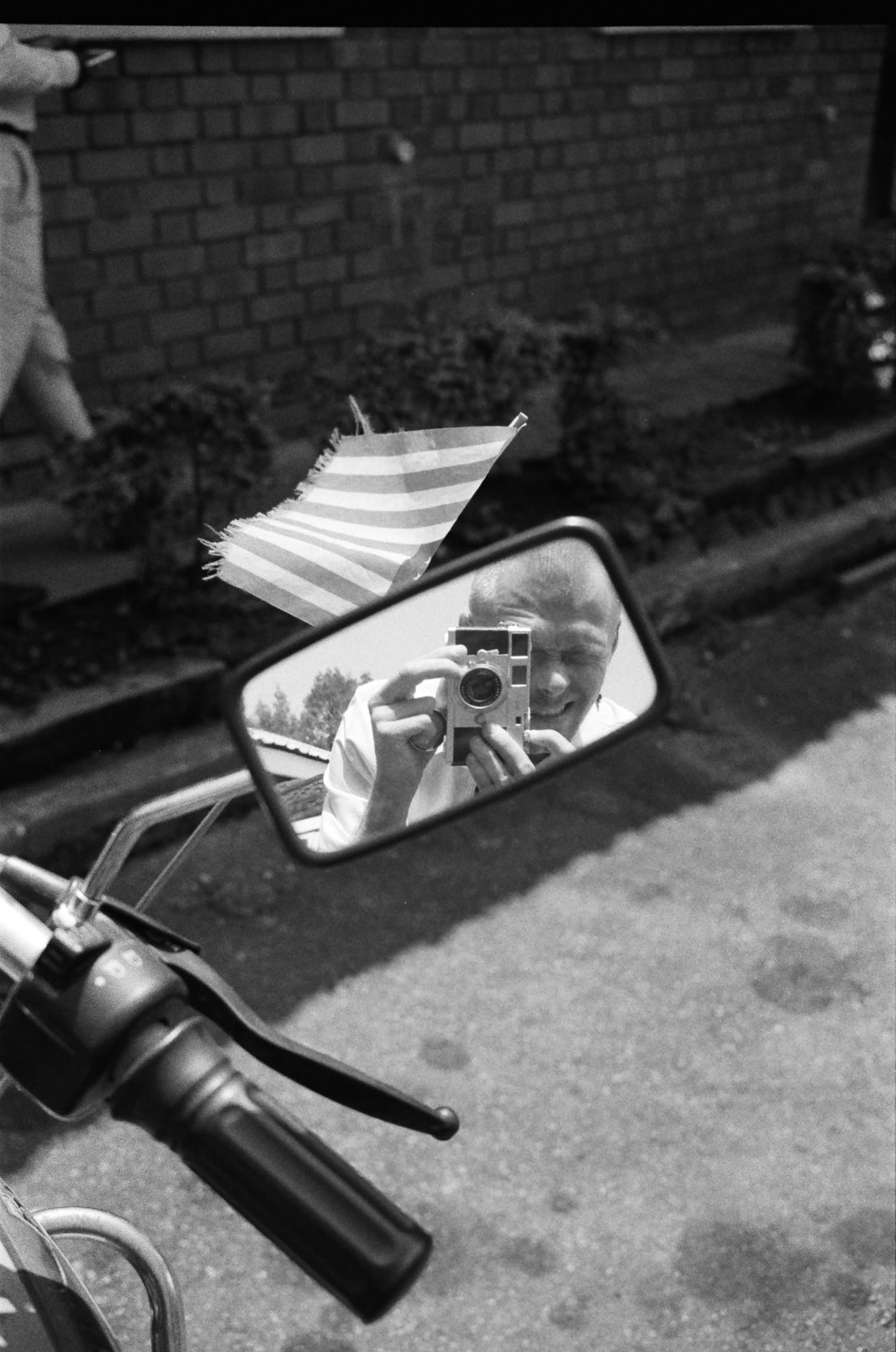
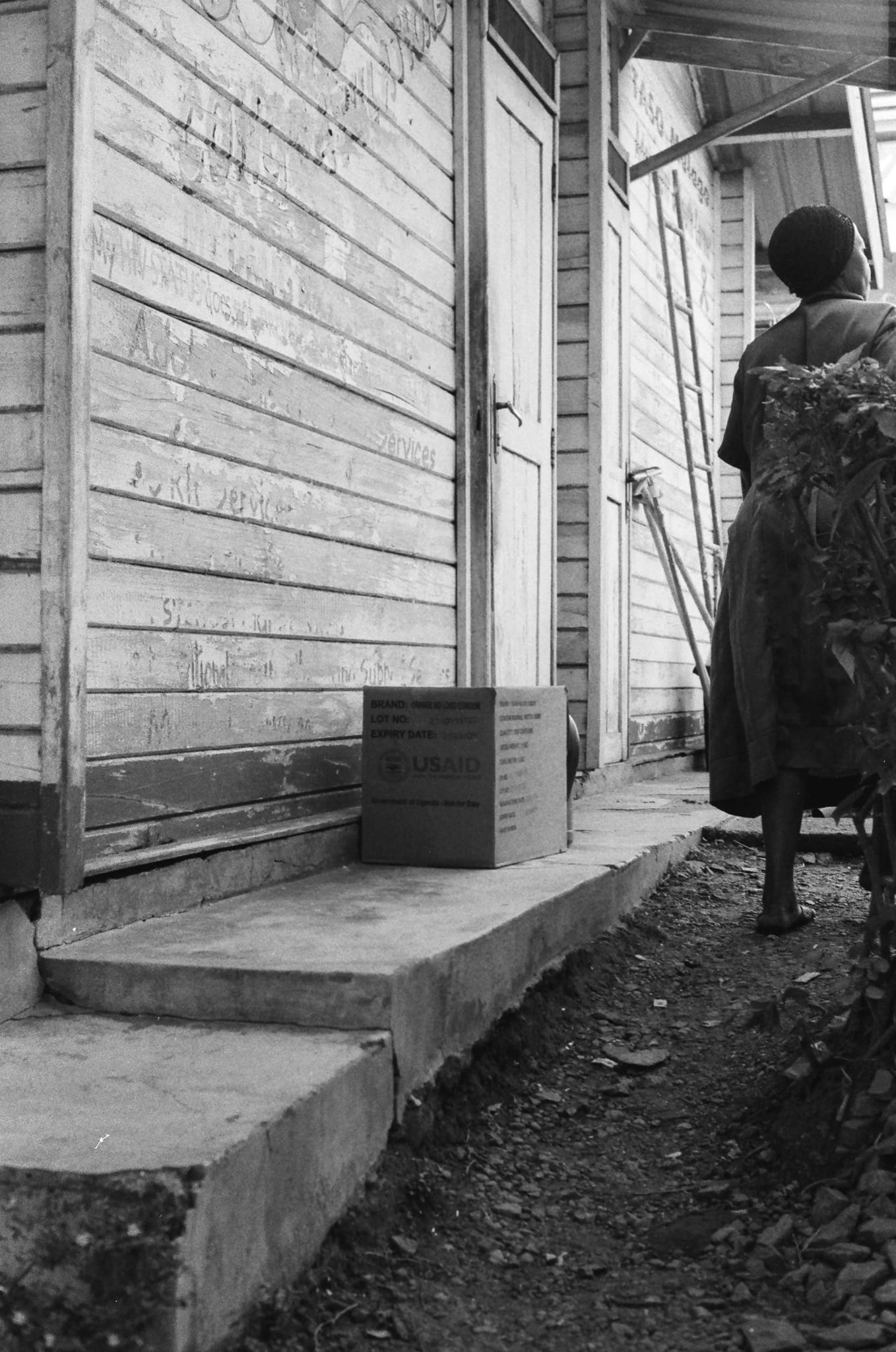
Scenes at TASO Entebbe (left and center) and TASO Mulago in Kampala (right) on 30 and 31 July 2025. Analog 35mm photos by Ben Eveslage.
In most countries, HIV care is more clearly divided: government hospitals provide ART, while NGOs focus on outreach. In Uganda, those lines blur. TASO occupies both spaces at once, a model that works, but one that exposes a critical vulnerability. When external funding falters, the impact is immediate.
TASO’s clients know this. When U.S. government stop-work orders suspended much of the organization’s funding in January 2025, fear spread quickly. Many assumed TASO would close. Even now, as I write in December 2025, Google’s top autocomplete results for “Is TASO…” include closed, still operating, and alive?
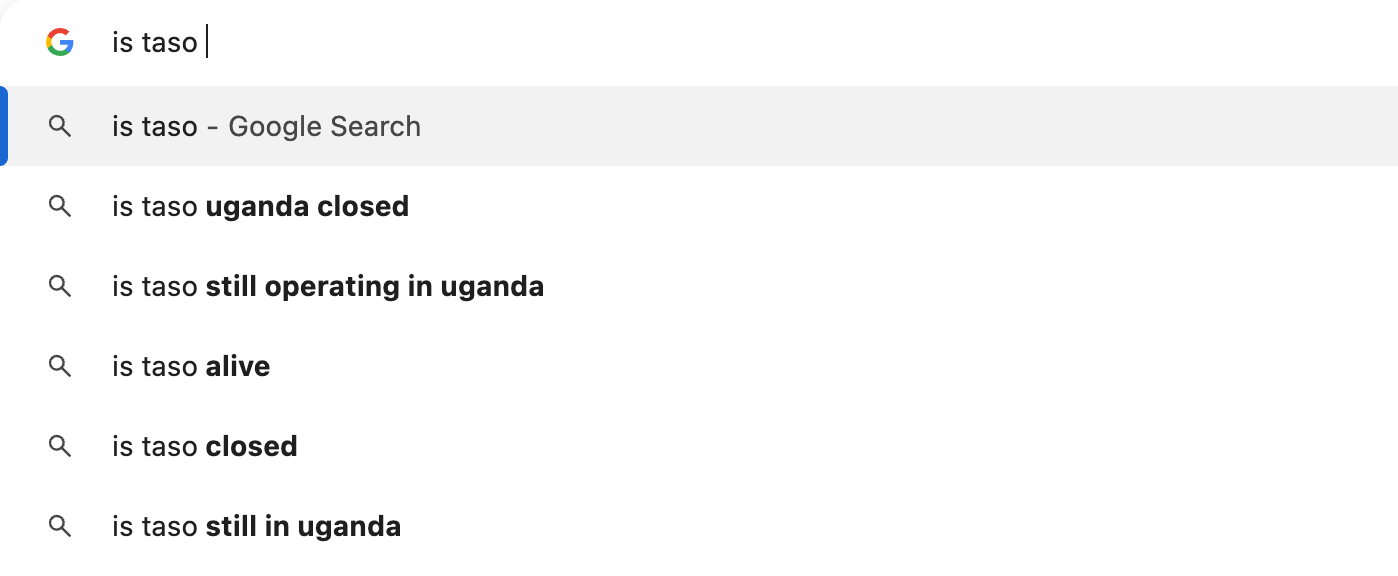
Standing there that morning, it was clear the clinic was more than a service point. It was an anchor. I focused on the main entrance and imagined the thousands who had passed through, those arriving in the 1990s when diagnosis felt like a death sentence; those returning in the early days of ART, learning to hope again; and those who still come today. More than 6,000 people living with HIV currently access ART through TASO Entebbe.
A black and blue dress with matching heels
A staff member soon emerged through the entrance I had been looking through moments earlier, greeted us warmly, and led us upstairs to a boardroom. There, we were offered tea or coffee and small snacks—bananas, nuts, and samosas—gestures of hospitality that felt deeply ingrained.
Sarah Alinga, the clinic manager, entered wearing a navy-and-black dress and matching heels, her smile immediate. As I described the photography project, she gestured toward framed portraits lining the walls of founders, board members, former directors. The message was clear: these were the people who could speak to TASO’s origins, its legacy, its long arc of leadership. I gently redirected us. I wanted to meet the people working closest to patients.
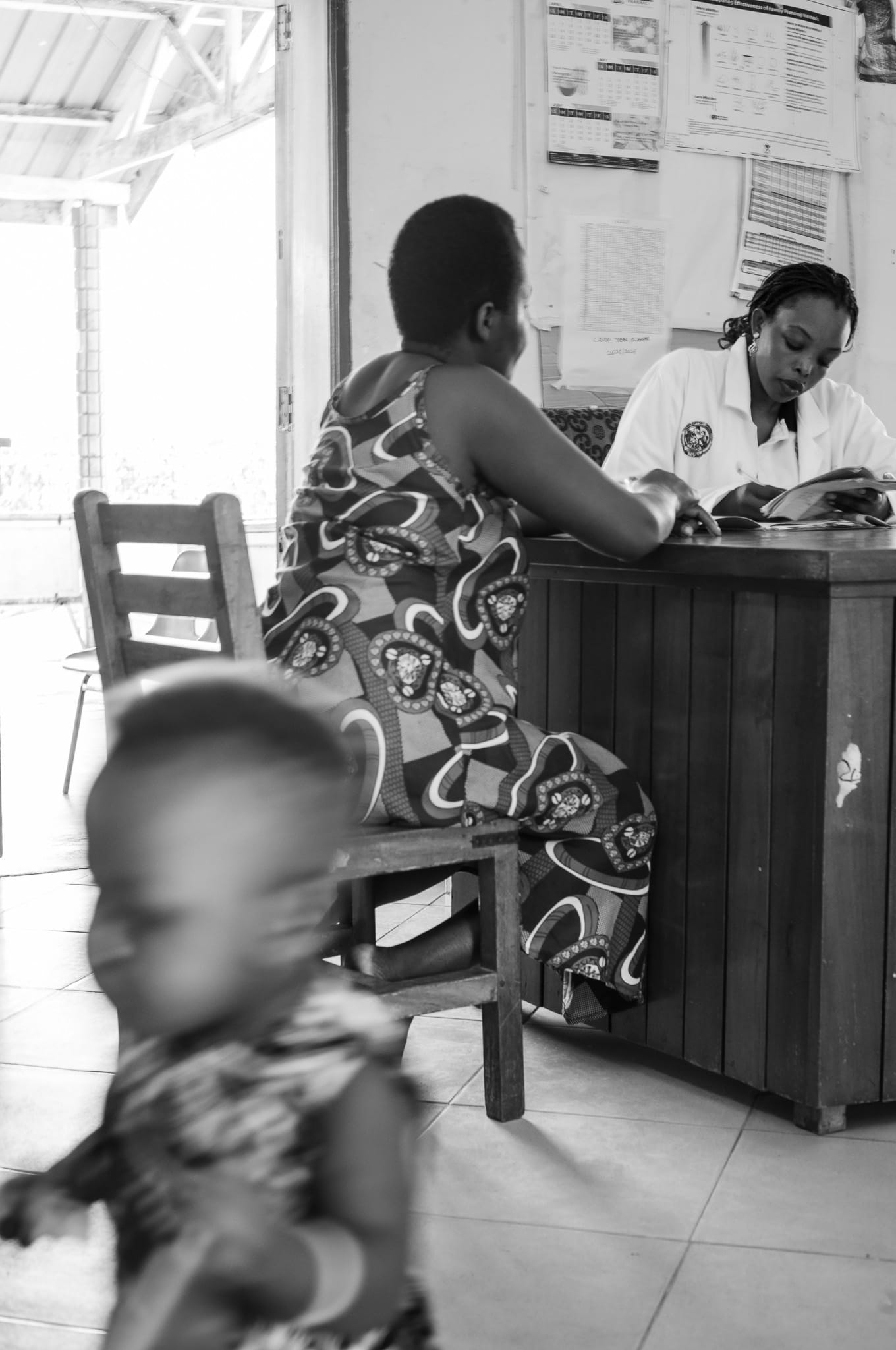
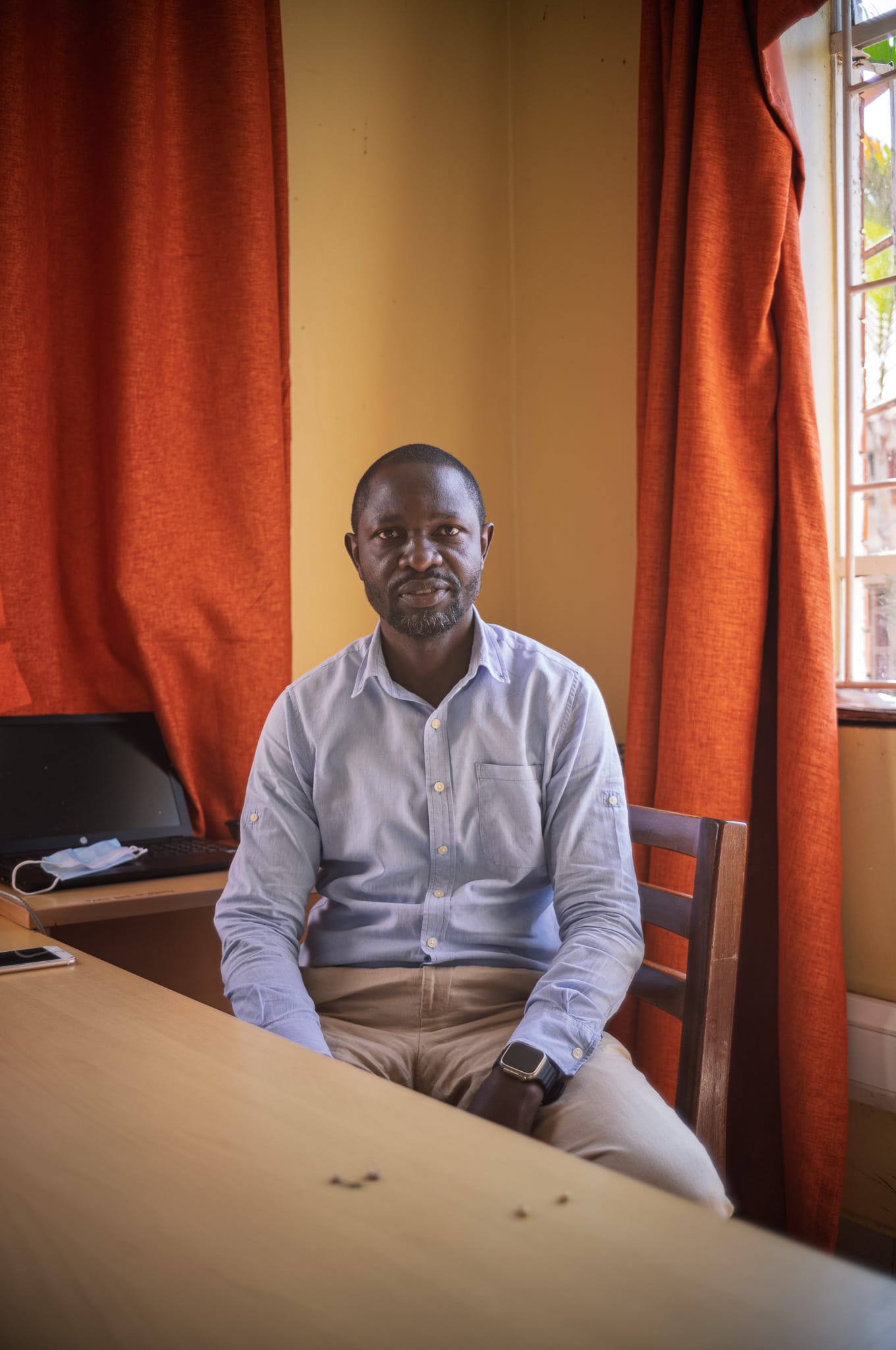
Staff at TASO Entebbe including Samuel Higenyi, Counselor; Nuriat Kajwejweta, Nursing Officer; and Richard Lutaaya, Psychosocial Counseling Coordinator (from left to right). Photos by Ben Eveslage on 31 July 2025.
She led us through the clinic, heels echoing softly as she introduced lab technicians, nurses, and counselors. An older man passed us twice, moving slowly, head down. When the tour ended, Sarah didn’t hesitate.
“You have to speak with Robert.”
Robert, living history of the HIV response
He looked up when he heard his name, smiling. Sarah leaned in, noting he seemed quieter than usual.
“I’m feeling a bit unwell,” he said. “But I’m free to talk.”
He guided us into a yellow counseling room and sat down. Over the next half hour, time seemed to collapse. Robert spoke as if his body carried the clinic’s memory: decades of fear, survival, science, and care. Listening to him felt like standing at TASO’s doorway itself, bearing witness to the countless lives that had crossed it.
Robert was 58 when we met. Though feeling under the weather, his fatigue lifted once he began speaking. His hands traced diagrams in the air. Whatever he was fighting physically, it didn’t keep him from sharing what had long since become muscle memory.
He was 34 when he learned he was living with HIV, almost by accident. He had gone to the clinic with his brother, who had been persistently ill and tested negative. On impulse, Robert decided to test too.
“They told me I was positive,” he said. “I didn’t agree.”
He tested again. And again. “That’s how I came to know my status.”
It was 2001. Uganda had no national ART program. “They gave us Septrin and counseling,” he said. “How to eat well. How to stay strong. There were no ARVs. Many people died.”
He had a child just over one year old. “I prayed to God,” he said. “Give me six years. Let me leave this child when she is seven or eight.”
That was the future he allowed himself.
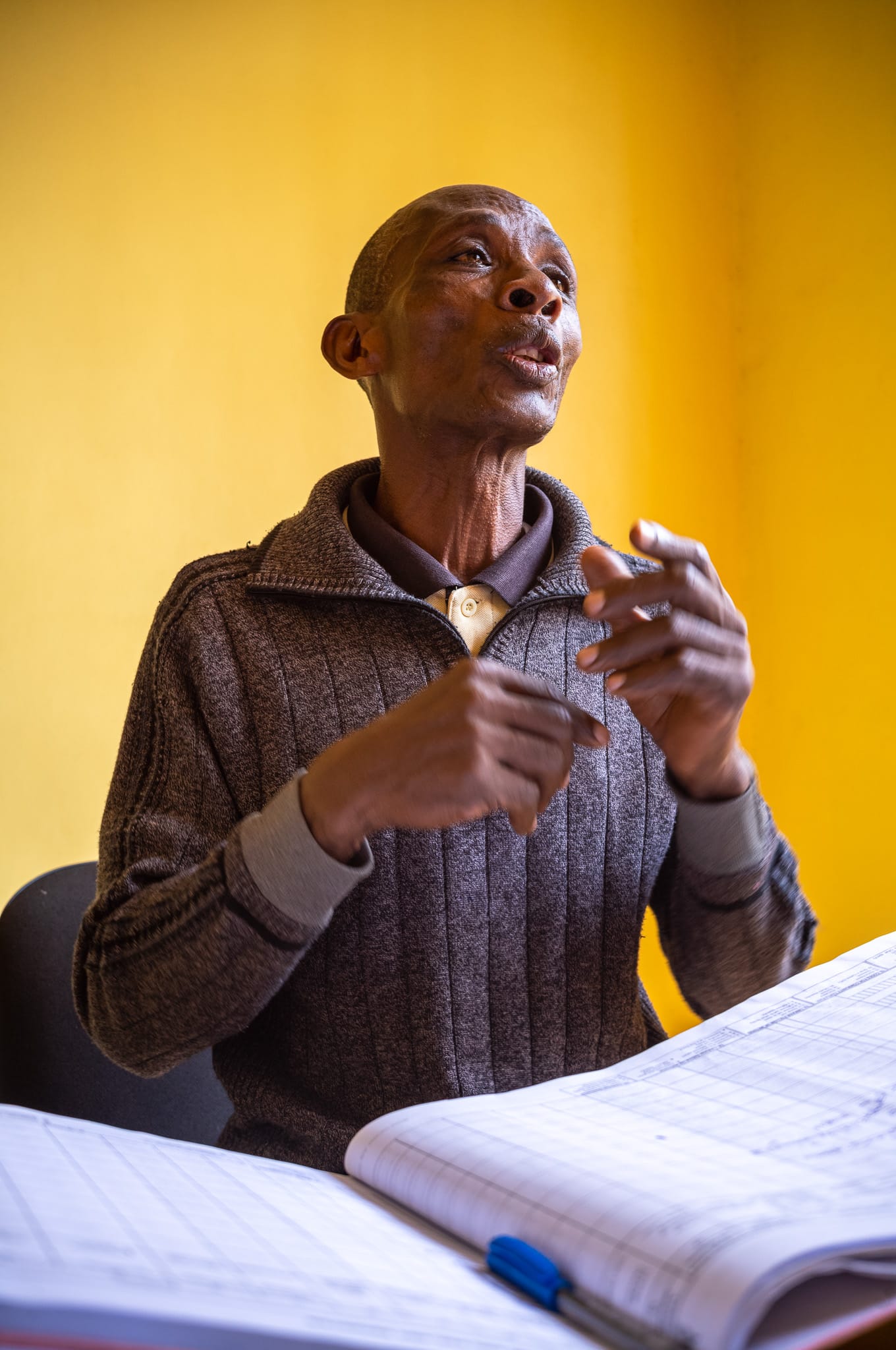
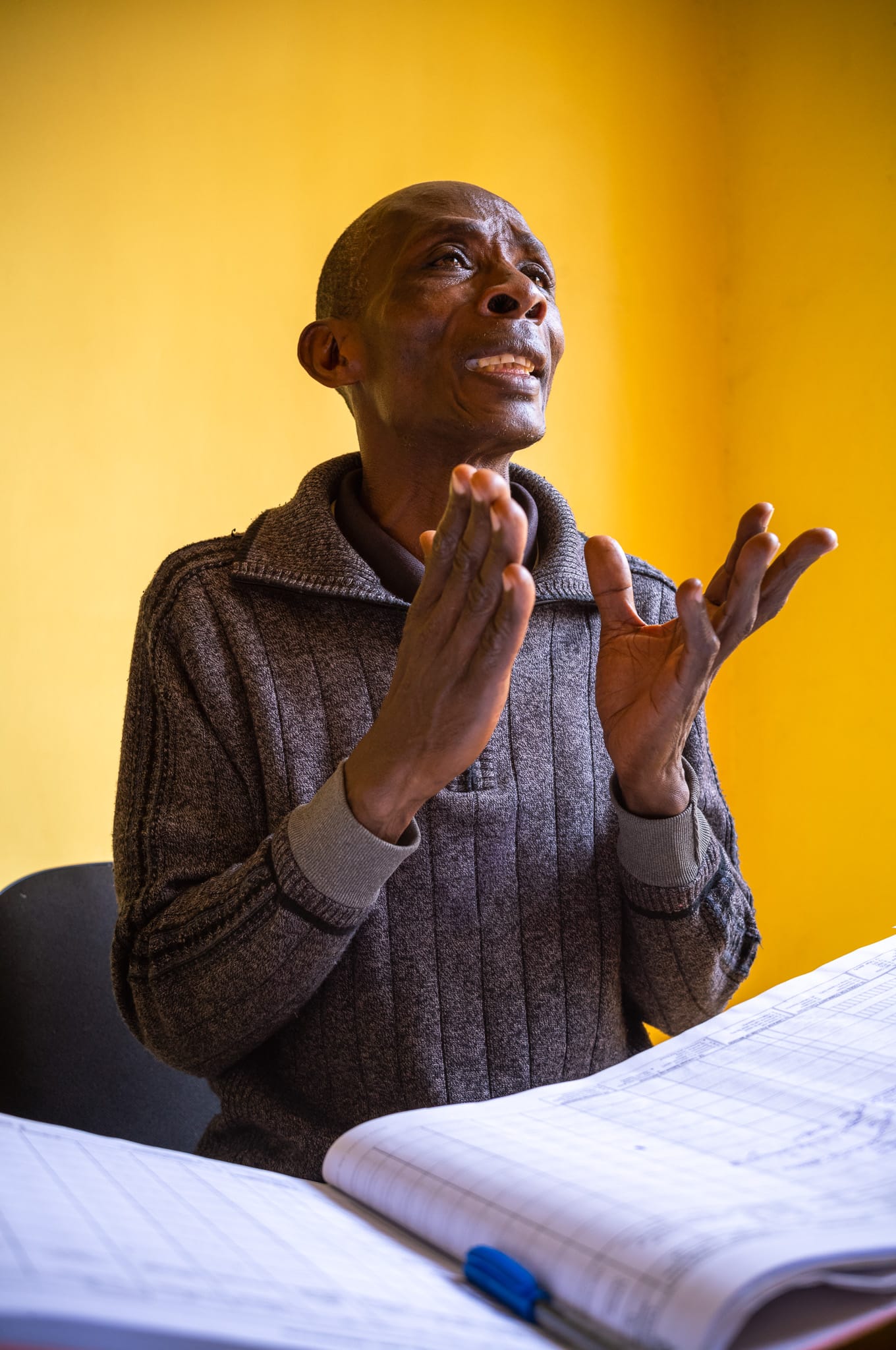
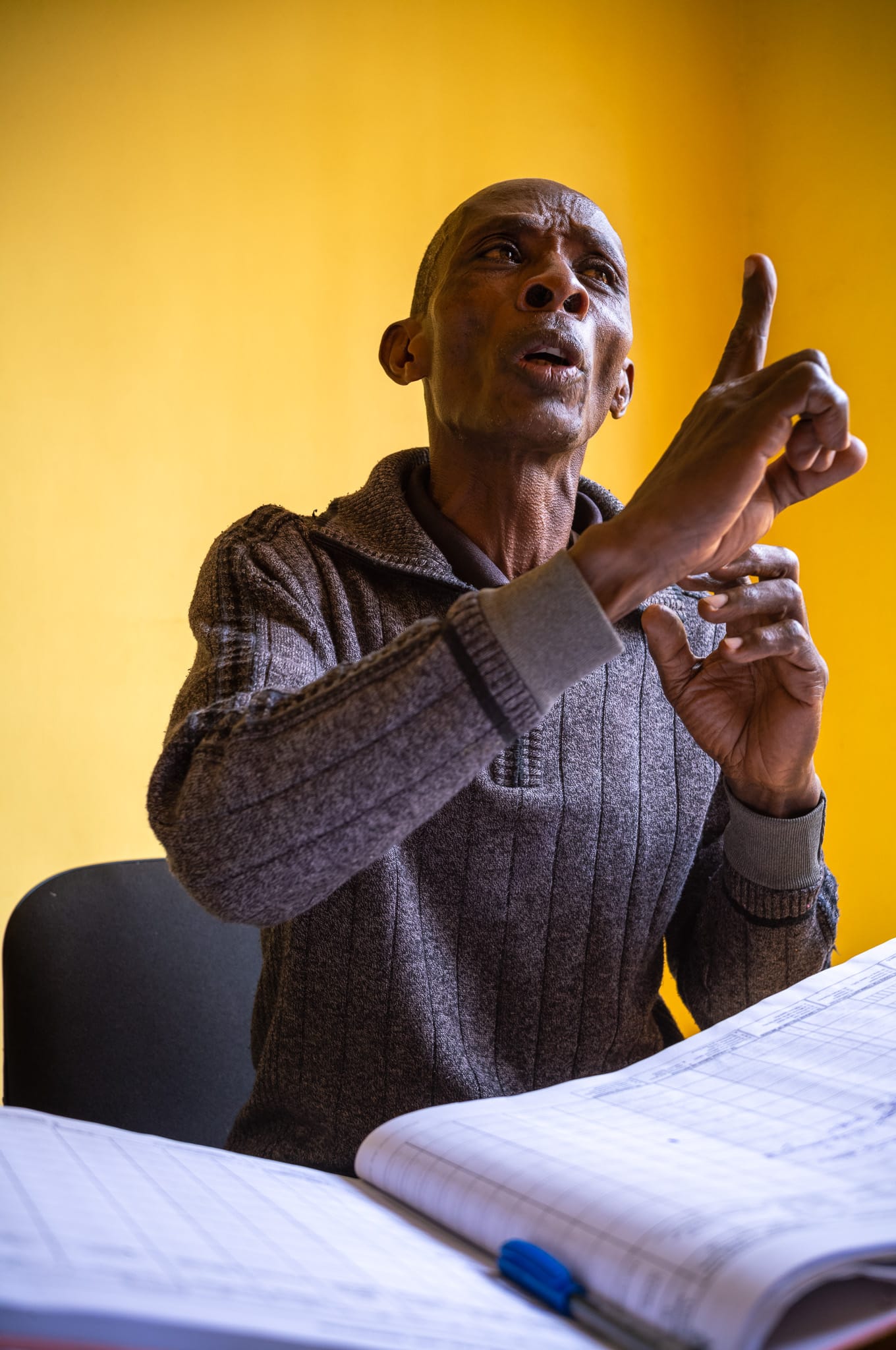
Robert is animated explaining key concepts of his counseling and advocacy, including HIV transmission, viral suppression, U=U, and stigma to Louis at TASO Entebbe on 31 July 2025. Photos by Ben Eveslage.
In July 2003, shortly after the launch of PEPFAR, President George W. Bush visited TASO Entebbe. Robert was there.
“There is a picture of us together,” he said. “He wanted to see the people whose lives were being saved.”
For Robert, PEPFAR meant time: the possibility of watching his child grow.
When ART arrived in 2004, he enrolled in one of Uganda’s earliest ARV research programs.
“I used to take 21 tablets a day,” he said. “Six in the morning plus Septrin. Seven in the afternoon. Seven in the evening.”
Many couldn’t tolerate the drugs. Some stopped. Too many died.
Robert stayed.
As he spoke, I noticed his lean face, subtle, but telling. Early ART regimens were known to cause lipoatrophy, a loss of fat in the face and limbs, one of the visible marks carried by long-term survivors of those first treatment eras. His body, in subtle ways, bore the history of HIV science moving forward through trial, error, and persistence.
Undetectable and showing up at every opportunity
In 2005, Robert became the first client at TASO Entebbe with an undetectable viral load. At the same time, researchers were puzzled by another fact of his life. His wife, Resty, tested HIV-negative in 2002 and never acquired HIV.
“We are living in a discordant relationship,” he said. “It disturbed the scientists a lot.”
Together, Robert and Resty enrolled in early research on sero-discordant couples. It was not easy. “From 2004 to 2005, I never slept with my wife without a condom,” he said. Later, as part of the study, they were instructed to have unprotected sex under careful monitoring. Researchers did not yet know if viral suppression prevented transmission.
“They found that when someone’s virus is suppressed,” Robert said, “you never transmit the virus to your partner.”
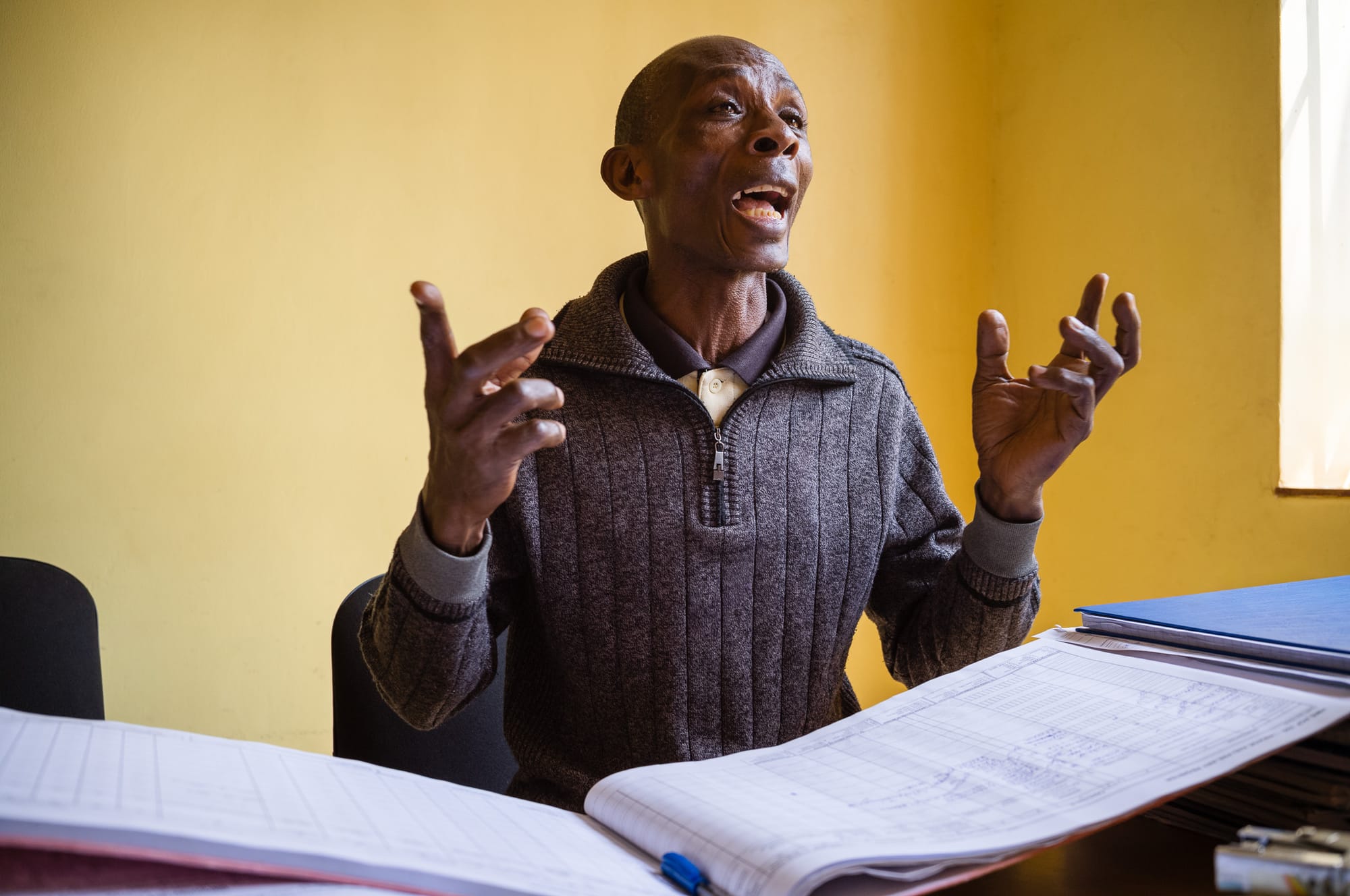
The research concluded in 2007. It made space for something radical at the time: the beginnings of what the world now calls Undetectable = Untransmittable, or U=U. This science-backed message confirms that people living with HIV who are on treatment and are virally suppressed do not need to live in fear of transmitting HIV to their partners.
That knowledge changed Robert’s path and revolutionized HIV programs with evidence powerful enough to begin undoing the persistent stigma affecting people living with HIV.
Expert clients: The power of lived experience
In 2007, Robert began supporting other clients by sharing his testimony. That work eventually took him to TASO’s clinic in Jinja in 2010, where he served in an informal role. In 2012, he returned to Entebbe to become an expert client. TASO gave him a small office near the entrance, which became the first place most clients pass through.
“TASO trusted me with this office,” he said. “Clients have not disappointed me, and I’ve not disappointed them.”
“To be an expert client,” he explained, “is to help others adhere. You give testimonies—how you’ve lived.” Expert clients, he added, must be on treatment, undetectable, and live as role models. “Since 2005,” he said, “I’ve never had detectable viral load.”
He spoke about the years when an HIV diagnosis often tore families apart. Discordant couples separated. Gender-based violence followed disclosure. Children suffered the consequences.
“So we tried to intervene,” he said. “To teach them how to live.”
He does pre- and post-test counseling, opens files, delivers results, follows up by phone, checks on side effects, and sometimes visits people at home.
“Even this week,” he said, tapping the register, “I have seven new clients.”
As he spoke, Robert’s energy shifted. His hands moved faster. He turned toward Louis, slipping into counselor mode, rehearsing explanations he has given thousands of times.
He flipped through an animated flip chart with diagrams that he uses to explain HIV transmission, treatment, and viral suppression to his clients.
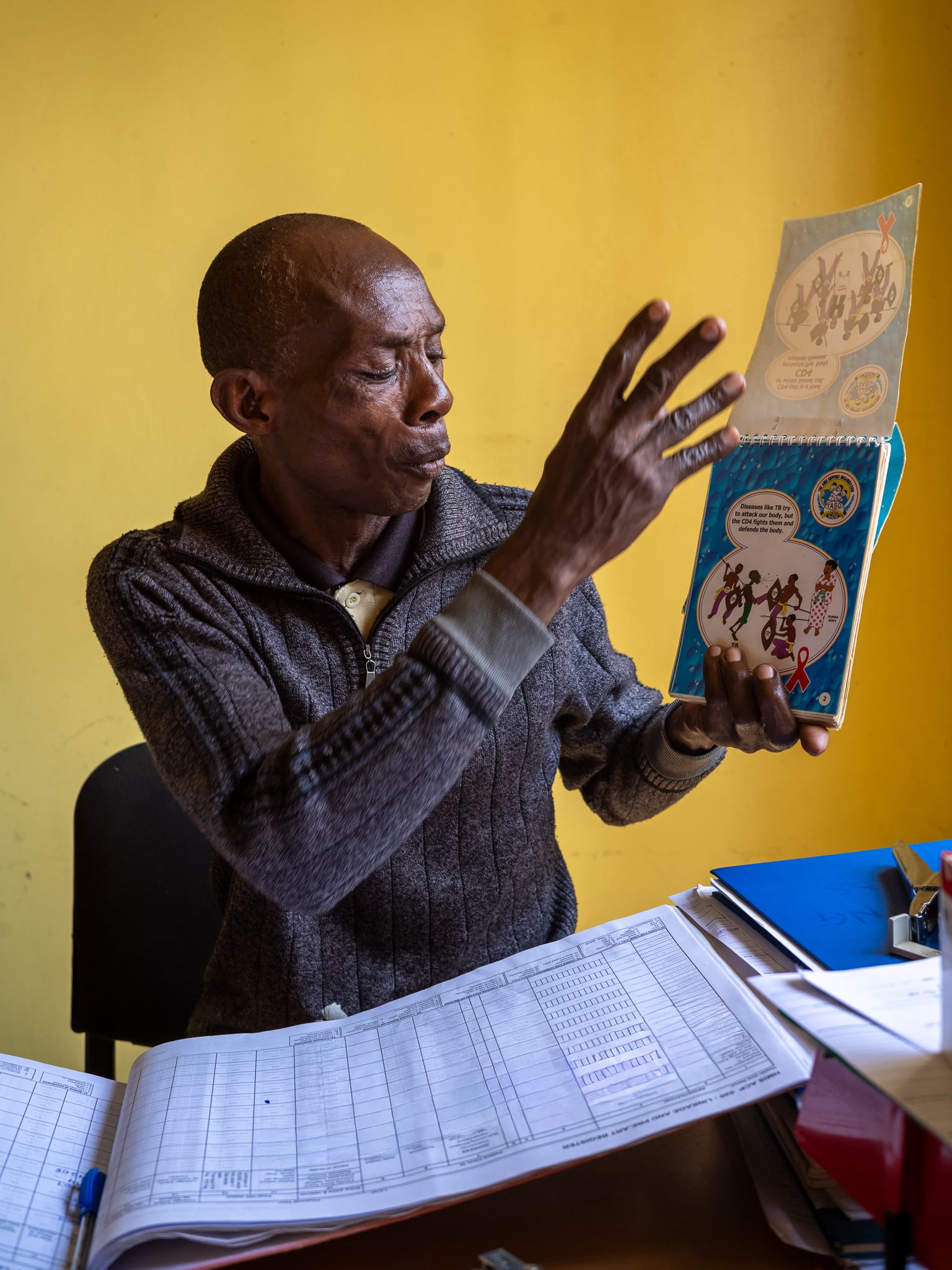
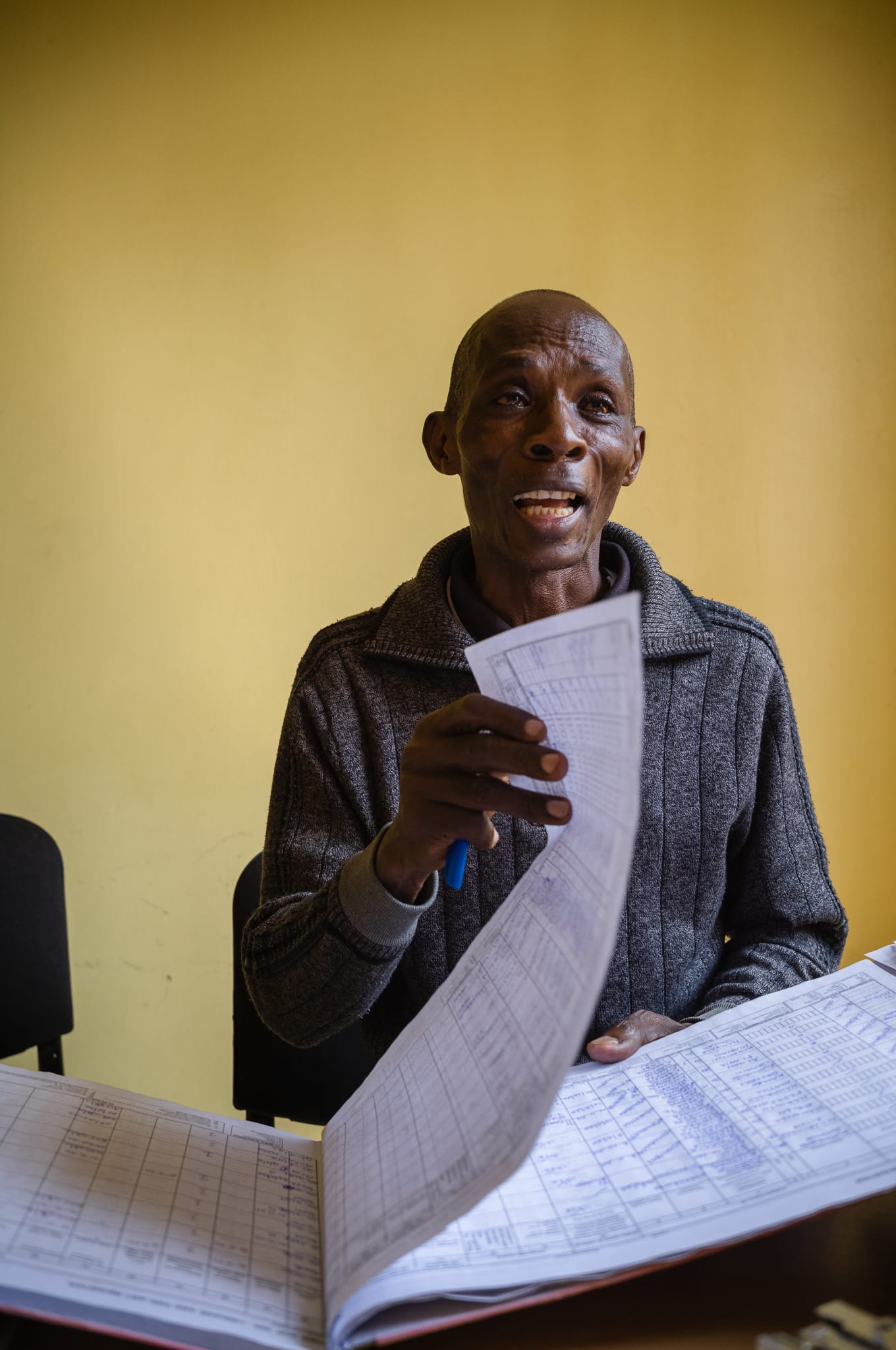
Robert explains the role of an expert client at TASO Entebbe on 31 July 2025. Photos by Ben Eveslage.
The work is not salaried. Expert clients are volunteers, supported only with transport and lunch. “So we must have other work,” he said. “I rear chickens. That is how I sustain.”
From the outside, it feels like a precarious balance. For Robert, it is simply how survival has evolved, lived experience turned into responsibility, honesty turned into care.
When our conversation ended, Robert went to rest. He looked drained, but lighter too, as if telling the story had taken something out of him and given something back at the same time.
His life and body trace the arc of the HIV response itself: from uncertainty to evidence, from survival to service, from being studied to becoming a teacher.
Shedding layers: living through the in-between
After leaving the counseling room, I met briefly with other staff across the clinic, then returned to Sarah’s office. Together, we took stock of what I had seen and heard.
She spoke candidly about the clinic’s reality. Staffing had fallen from around seventy in 2012 to just twenty-one contracted staff today. The clinic now relies heavily on supplementary counselors and expert clients to keep services running. Robert, she explained, receives about 25,000 Ugandan shillings a day—roughly $7 USD—enough to cover transport and lunch. Task shifting, once an efficiency measure, has become essential, with expert clients carrying responsibilities that were once the domain of clinicians.
And yet, Sarah spoke with pride. More than 6,300 clients continue to access ART at TASO Entebbe. There have been no HIV-positive babies through the PMTCT program in over five years. Just last month, two clients married—milestones that once felt unimaginable.
To survive the current funding landscape, the clinic is experimenting. Membership contributions have increased. Clients have organized welfare schemes to cover drugs for opportunistic infections. TASO’s leadership is exploring longer-term sustainability options, including private services that could help subsidize free HIV care. None of it is simple. All of it is uncertain.
Still, people like Robert keep showing up.
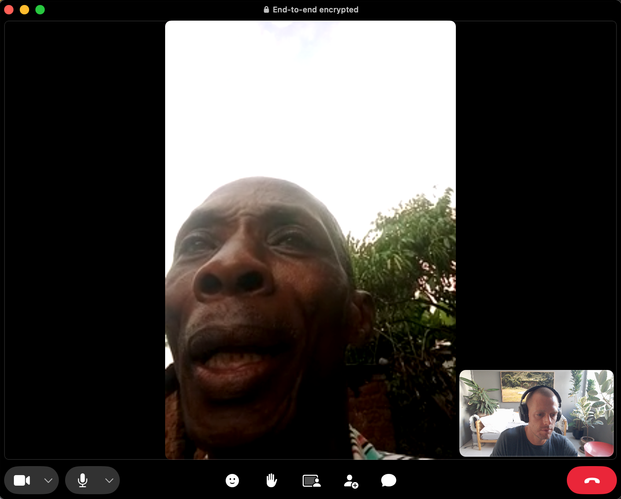
Our conversation did not end that day. In the weeks that followed, Robert and I stayed in touch through WhatsApp messages and video calls. He shared updates from the clinic, asked questions about the photographs, and spoke about client initiatives he was trying to sustain now that donor funding had disappeared. He described organizing discordant couples with whatever resources he could mobilize. “I am living in a discordant relationship,” he told me again, walking through his village at sunset. “I am the role model for these people.”
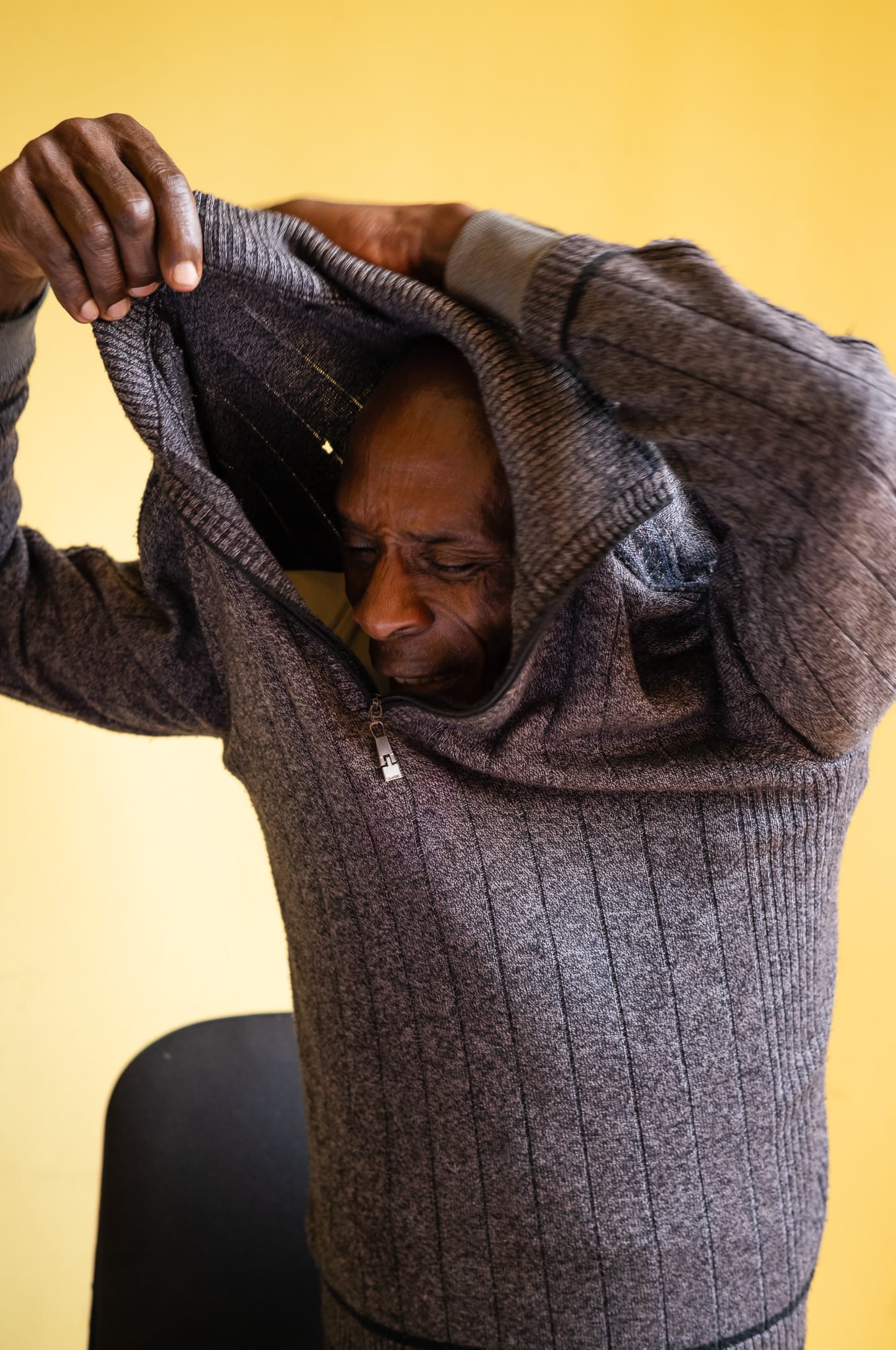
As I left the clinic that afternoon, I kept thinking about that yellow counseling room when time stopped. As Robert explained his work, the sun climbed higher and the room grew warm. Mid-sentence, he paused and pulled off his sweater. In that moment, I pressed the shutter. The frame caught him mid-movement.
Later, Robert told me he didn’t care much for the image. It wasn’t flattering, and as he wrote to me on WhatsApp, “This one I didn’t like much because its meaning doesn’t come out clearly.”
But to me, it felt like a symbol of a larger, more difficult moment. A shedding of a layer that was not chosen, but forced by abrupt funding cuts, stop-work orders, and decisions that arrived unplanned and unphased. It came after years of gradual tightening, of knowing that change was coming, but not like this. What the image reflects is adaptation under strain, as people on the ground adjust in real time with fewer resources, thinner margins, and no clear sense of what follows.
It reminds me that while the HIV response is often measured in targets, indicators, and policies, its story is also written in bodies. In people like Robert—living testaments to the miracles of science he helped shape, and to the losses carried along the way: stigma endured, friends lost, and the fear of losing more as resources fall away.
The cost of disruption is not abstract. It is absorbed by people like Robert, whose body holds both the triumphs of science and the unfinished work that remains.
Featured local organization
The AIDS Support Organization (TASO)
Founded in 1987, TASO is Uganda’s pioneering NGO in the HIV/AIDS response. It provides HIV testing, treatment, counseling, prevention of mother-to-child transmission (PMTCT), home-based care, psychosocial support and community outreach across multiple districts.
#close-up series: This series centers on individuals—the doctors, nurses, outreach workers, and advocates who share the human story of ending AIDS. Each piece captures one person’s story through portraiture, environment, and voice, pairing photographs with excerpts from intimate conversations. Explore the series →

Member discussion